blogs
Home
»
Articles
»
Europe Isn’t Ready for AI’s Job Shock — Training and Skills Lag Behind
AI/ChatGPT

Europe Isn’t Ready for AI’s Job Shock — Training and Skills Lag Behind

August 18, 2025
-
7 min read

Europeans aren’t ready for the job onslaught that AI’s impact will bring.

Demis Hasabis, founder of Google’s DeepMind, just shared his views on the prospects of Artificial General Intelligence (AGI) and how it is likely going to shape employment prospects.

When we look at the EU specifically, it’s looking even more dramatic:

- AI is already reshaping Europe’s job market. Recent data shows that 34% of European jobs are at risk of automation displacement, with sectors like accommodation, food services, and retail facing the highest exposure.

- The skills gap is real and growing. Only 39% of European employees have received formal AI training, compared to 52% in the U.S. This lack of structured upskilling means most European workers are unprepared for the rapid changes ahead. (Looking for AI workshops? Check Influence Builders)

- Worker anxiety is widespread. More than two out of three European employees fear job losses due to AI, with 68% expecting fewer employees will be needed as AI systems become more established.

- Job creation is happening, but not where it’s needed most. Employment growth is strongest in roles highly exposed to AI, while jobs less likely to be automated (often manual or service roles) are shrinking as a share of the workforce.

- Without immediate investment in continuous, formal AI training and reskilling, the continent’s workforce will struggle to adapt, and the gap with global competitors, especially US and China (and Middle Eastern ones!) will only widen

What is your organization doing to keep up..?

cc David Timis

This was originally posted on Andras Baneth's LinkedIn account.

Projects & Ventures
Yellow stylized tree with broad leaves on a blue background.
EU Training

Our trainings are designed for public affairs, corporate affairs and communication teams who want to work more efficiently with AI and improve the quality of their output.

Visit
White stylized letter i and B forming an arrow pointing right on dark blue background.
Influence Builders

Our trainings are designed for public affairs, corporate affairs and communication teams who want to work more efficiently with AI and improve the quality of their output.

Visit
Abstract blue circular logo with upward curving lines resembling a stylized fan or blades.
Retora

Retora is the strategic persuasion platform for political, PR, and communications teams. Simulate how your audience responds — and get the intelligence to make your message land.

Visit
Glowing blue and purple lightbulb encased in a glass bubble with a dark background.
Beyond the Bubble

Podcast for open conversations in Brussels on global affairs, politics, psychology, AI, communications, history, religion and everything in between, from a European perspective.

Visit
Man in white shirt and gray pants speaking on stage next to large red TEDx letters.
TEDx Talks

Retora is the strategic persuasion platform for political, PR, and communications teams. Simulate how your audience responds — and get the intelligence to make your message land.

Visit
The Ultimate EU Test Book Administrators 2025 by András Boneth with strategies, skills, and advice.
The Ultimate EU Test Book & Handbook

Retora is the strategic persuasion platform for political, PR, and communications teams. Simulate how your ...

Visit
Bright conference room with wooden table, chairs, large window, plants, and decorative fireplace.
Ambiorix Center

Podcast for open conversations in Brussels on global affairs, politics, psychology, AI, communications, history, religion and everything in between, from a European perspective.

Visit
The Right Street logo with stylized red and white icon on black background.
Right Street Digital

Our trainings are designed for public affairs, corporate affairs and communication teams who want to work more efficiently with AI and improve the quality of their output.

Visit
Three young girls lying down reading books against a bright blue background with colorful shapes.
Diákszempont

Learn about the philosophy of Diákszempont Elementary and High School, where the child comes first because we believe that children can only be truly free and happy in a supportive environment.

Visit
Featured

Featured articles
and Insights

EU affairs
AI/ChatGPT
The Evolution of EPSO: A Visual Journey from First Candidates to Future Prospects

This compilation takes us through the history of the first #EPSO candidates, showcasing their journey and achievements from the very beginning to the present day—and even looking ahead.

A compilation of the first #EPSO candidates throughout history, until today and beyond.

(Have you played with ChatGPT-4o's new image capabilities? Pretty impressive.)

*This was originally posted on Andras Baneth's LinkedIn account.

EU affairs
From Unsolicited Pitch to Published Masterpiece: The Journey Behind The Ultimate EU Handbook

Discover the inspiring story behind The Ultimate EU Handbook, a book born from the unexpected connection of a chance pitch and years of creative collaboration.

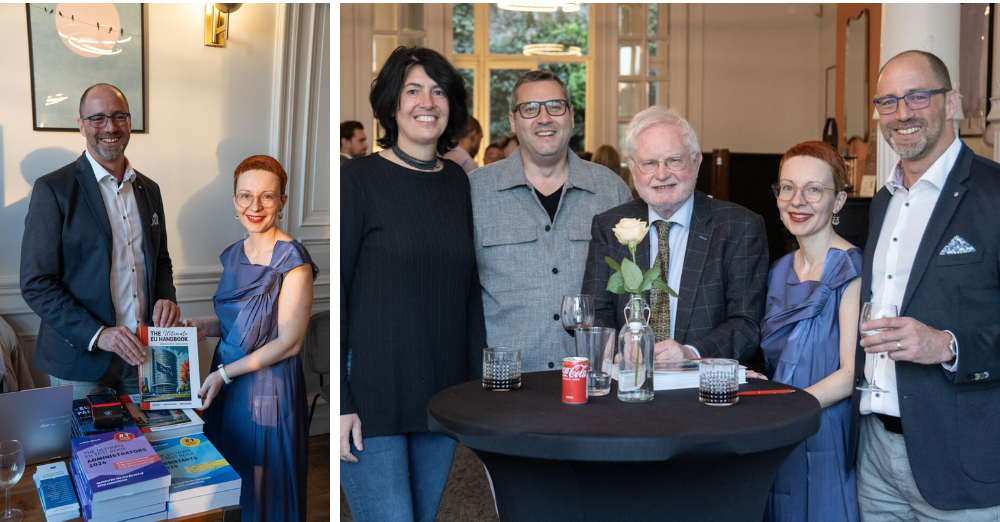
20 years ago, John Harper said 'yes' to an unknown person's unsolicited book pitch, which set of a chain of positive events. Yesterday, another book came to be as a result of two years' intense work and creativity of Sonia Gongu, Martin Tomov, Ljiljana Pavkov... and 'The Ultimate EU Handbook' was born.

Special thanks to Maryana Panyevina, Klym Ahrykov and David Meszaros for your support to make the launch event at Ambiorix Center & Podcast Studio special.

🇪🇺🙏📚

*This was originally posted on Andras Baneth's LinkedIn account.

Other
The Human Condition: Honest Talks About Who We Really Are

What began as a discussion about burnout quickly turned into an exploration of something deeper. In my conversation with Dr. Vasadi Anna, a psychiatrist with decades of experience, it became clear that burnout isn’t just about long hours or stress—it’s rooted in expectations, upbringing, and the invisible pressures we internalize from an early age.

English summary of the latest episode of András' Hungarian podcast, 'Lélek Algoritmus – Ilyen az ember (avagy beszélgetések egy pszichiáterrel)' – 'The Soul’s Algorithm: The Human Condition (Conversations with a Psychiatrist).

What began as a discussion about burnout quickly turned into an exploration of something deeper. In my conversation with Dr. Vasadi Anna, a psychiatrist with decades of experience, it became clear that burnout isn’t just about long hours or stress—it’s rooted in expectations, upbringing, and the invisible pressures we internalize from an early age.

Burnout: More Than Just Exhaustion

Burnout gets thrown around a lot, but what does it actually mean? Many assume it’s just extreme fatigue, but as Anna pointed out, it’s something deeper. Burnout drains you emotionally, mentally, and even physically. It’s not the kind of tiredness that a weekend off can fix.

A key distinction Anna made: while depression can affect every part of life, burnout is usually tied to work. But it doesn’t stay there. It spreads—first to colleagues, then to family, then to an overall sense of disillusionment.

The Perfectionist’s Trap

Burnout isn’t just about overworking—it’s about overworking with the wrong mindset. People who push themselves too hard, who never feel their efforts are enough, who equate self-worth with productivity—these are the most at risk.

A common misconception: If I love my work, I can’t burn out. But passion doesn’t shield you. In fact, it often makes things worse. Overcommitting, ignoring personal limits, and relying on caffeine or alcohol to keep up are all red flags.

The Long Shadow of Childhood Expectations

Why do some people burn out while others keep their balance? Often, it starts in childhood.

Many of us grow up believing that our worth is tied to achievement. If we didn’t excel, love and approval felt conditional. Some parents—often unknowingly—reinforce this by setting impossibly high standards or withholding affection when a child falls short. Over time, this creates a need for external validation, making burnout almost inevitable.

Take elite athletes. Their entire identity is wrapped up in performance. When they lose, it’s not just a setback—it feels like a loss of personal value. The same happens in workplaces. A high achiever who misses a promotion doesn’t just feel professional disappointment—they feel like they have failed as a person.

Midlife Crisis: Burnout of the Soul

This naturally led us to midlife crisis, which, in many ways, is burnout playing out on a larger scale.

Both stem from the same root: spending years chasing external markers of success without stopping to ask, Is this what I actually want?

The midlife crisis tends to hit in the 40s or early 50s, often when several pressures collide:

  • Aging Parents: The growing responsibility of caring for elderly parents forces many to confront their own mortality.
  • Teenage Children: At the same time, kids are becoming more independent, adding another layer of emotional complexity.
  • Career Pressures: By midlife, most people have built careers, but many start questioning if they’re on the right path.

It’s a perfect storm of obligations, internal and external, that makes people reevaluate everything—from their job to their marriage to their purpose.

Finding a Way Forward

So, how do we deal with burnout and midlife crisis without making rash decisions?

  1. Rethink Success – Instead of measuring success by salary, job title, or external validation, define it in terms of fulfillment and balance. If your work is draining you, can it really be called success?
  2. Recognize the Warning Signs – Losing interest in work, feeling detached, and struggling to muster enthusiasm are all early signs of burnout.
  3. Set Boundaries – Work will always demand more. It’s up to you to decide what is enough.
  4. Address Deep-Seated Patterns – If your self-worth depends on achievement, it might be time to rethink where that belief came from. Therapy and self-reflection can help break the cycle.
  5. Embrace Change – A midlife crisis isn’t necessarily a crisis—it can be a wake-up call. Maybe it’s time for a career shift, a realignment of priorities, or simply a different perspective.

Final Thoughts

Burnout and midlife crisis aren’t just work problems or age-related phases. They’re signals—urgent ones—telling us that something needs to change. The real question isn’t How do I push through? but Am I living a life that actually fits me?

If the answer is no, maybe the crisis isn’t a disaster. Maybe it’s an opportunity.