Why You Should Get Smarter About Science
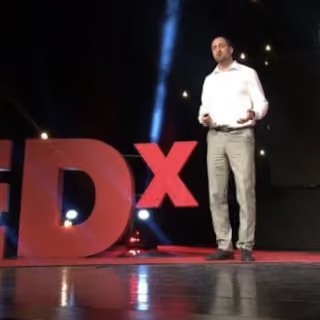
An interview with me in the Public Affairs Council’s December 2017 Impact newsletter on science, policy and communication.
The decision by Sam Clovis to withdraw his name from nomination as Under Secretary of Agriculture for Research, Education, and Economics wasn’t just because of his relationship to a President Trump campaign adviser who lied to the FBI about his Russian connections.
And it wasn’t just because of controversial remarks the former radio talk show host had made about, among other subjects, former President Obama’s birthplace.
Clovis was forced to withdraw because he had no background in science. By law, the post for which he was nominated requires that the undersecretary be “among distinguished scientists with specialized training or significant experience in agricultural research, education, and economics.”
A degree of sophistication about science is now necessary not just for those nominated for high government positions, but for more and more professionals who deal in public policy — or even communicate about it.
And that’s certainly the case with the Department of Agriculture, which as Michael Lewis writes in Vanity Fair, “runs 193 million acres of national forest and grasslands” and “is charged with inspecting almost all the animals people eat, including nine billion birds a year.” Buried inside USDA “is a massive science program, studying, among other arcane subjects, catfish breeding and bee-colony collapse.”
A similar story could be told about the Environmental Protection Agency as well as any number of other departments — and of the increasing level of knowledge required of elected officials who oversee them. The same is true, needless to say, of government relations professionals on whom they rely on for expertise.
Congress Can’t Know Everything
“Even most members of Congress that are on committees that deal in food and agriculture, for example, lack a technical or deeper understanding on policies they shape,” says András Baneth, managing director of the Council’s European Office. “They have some in-house experts, of course, but they are not themselves agronomists or environmental scientists. They are not formally trained in these areas, and it would be too much to expect such preparation from them. So there is a need for lobbyists with genuine expertise to help policymakers, especially on Capitol Hill, understand the issues.”
There’s a need as well, Baneth says, for government affairs professionals to communicate effectively about science with the general public. “Knowing how to talk about science in a credible and persuasive manner has never been more important,” he says, ‘and it will become increasingly important in the future.”
How the Public Learns ‘Science’
Not only are the issues facing policymakers becoming more technical in nature than in the past, but the way the public learns about complex scientific issues is changing.
Brian Koberlein, an astrophysicist who writes the science blog One Universe at a Time, puts it this way: “We’ve been communicating about these complicated matters at least since Carl Sagan in the 1970s. But back then, there were mainstream newspapers, TV and radio, with stories reported by professional journalists.”
“But with the rise of social media, professional journalists are competing against personal blogs that often have a vastly greater following — and can say anything. There are social media platforms that tell you the earth is flat, that evolution is ‘just a theory,’ and that global warming is a lie. These bloggers speak with great authority and gain adherents,” said Koberlein.
Despite this widespread challenge to the reliability of science, the public confidence in scientists “has remained stable for decades,” the Pew Research Center reports, citing data collected by the University of Chicago’s NORC Center for Public Affairs Research.
According to Pew, while only eight percent of Americans have a “great deal” of confidence in the media and six percent express a “great deal” of confidence in Congress, 40 percent have a great deal of confidence in the scientific community and half have some confidence in it. Only six percent put very little trust in scientists.
Only the military enjoys higher confidence than the scientific community. More than eight in 10 Americans are confident that scientists will act in the public interest, while 76 percent say they have a “fair amount” of confidence in scientists to act in the public interest.
How Scientists Speak
Part of the problem, Koberlein says, rests with the nature of science and the discipline that scientists exercise. Unlike bloggers, scientists tend not to speak with great certitude. “Scientists will say, for example, that ‘the evidence tends to suggest’ something. They are trained not to express themselves with emotion,” he says. “This puts them at a disadvantage when challenging, say, a global warming denier. In this environment, we not only have to inform the public. Often we have to re-educate the public. And when I am speaking not as a scientist but as a communicator about science, I have to call on a different skill set.”
Heather Buschman, who has a Ph.D. in molecular pathology and teaches a course in science writing at the University of California-San Diego, finds a problem in the health sciences comparable to what Koberlein sees in his field.
“Part of the challenge for communicating about science is in what I think of as the democratization of journalism,” Buschman says. “I read the other day, from a blogger, that cancer sufferers don’t need chemotherapy with all its side-effects. All you need to do is to ingest a lot of cannabis oil. The blogger also claims that ‘Big Pharma’ doesn’t want you to know that you don’t need chemo.
“The idea that people might believe this stuff and make life-and-death decisions about it frightens me. This also underscores the challenge facing all of us in the business of communicating about science.”
Even Scholarly Journals Can Err
Unfortunately, there’s no easy way to meet this challenge, even for people with a sincere desire to get the facts right. Simply citing articles published in scholarly journals to support a position or to show the weaknesses in another isn’t good enough. Suzanne Scarlata, a professor of biochemistry at Worcester Polytechnic Institute in Worcester, Mass., teaches classes in discerning scientific fact from fakery to graduate students.
“Some scholarly journals really are not peer-reviewed or properly vetted,” Scarlata says. “That’s why a recentreport purporting to link vaccination to autism caused a lot of problems, especially after some Hollywood stars who are anti-vax activists started quoting it.” (The report in question was published in The Lancet, a respected British medical journal, was later discredited and retracted by the journal “due to serious procedural errors, undisclosed financial conflicts of interest, and ethical violations.”)
Scarlata’s students are in graduate programs in chemistry and biochemistry and even they can be misled. “They are sophisticated in their own fields but not in others,” she says. “I urge them to check out the sources on their own.”
Appealing to Emotions
Apparently, just citing facts — even when well established — is no longer sufficient. “We know now that when you present information that challenges another person’s bias, they just dig in their heels,” Koberlein says. “This is all of us, not just global warming deniers. Facts themselves don’t persuade people. To speak persuasively about science, you have to tell stories that appeal to people’s emotions. This is hard for scientists.”
Baneth sees more than one challenge in communicating about scientifically complex matters. “First, we have to help scientists themselves communicate better about what they do and what it means,” he says. “Second, as public affairs professionals, we have to learn to communicate better about scientific matters ourselves. We have to know how to craft messages based on the findings of our organization’s engineers, for example. We have to learn to write responsible white papers that are both scientifically accurate and easily understood by the general public.”
Use ‘Vivid Metaphors’
It’s especially important to anchor arguments that involve technical concepts in vivid metaphors. “Even lobbyists who understand the complexities of a given issue often speak in language that is too abstract,” Baneth says. “When you do that, you leave it up to the listener to figure out what you mean, and that’s rarely helpful.”
He offers as an example the acronym PPB, which has a specific meaning to scientists and is a useful term. “It means parts per billion, and even if you say 50 PPB to the general public, 50 probably sounds like a big number. To explain what it really means, though, you might say that one PPB is equivalent to one drop of water in an Olympic size swimming pool — or in the large conference room where you might be speaking. Sometimes you have to be almost theatrical in concocting these images, which scientists are trained not to do.”
Room to Grow
Jim Fabisiak, a professor of environmental and occupational health at the University of PittsburghGraduate School of Public Health, provides another example. “To show what the release of one ton of VOCs — volatile organic compounds — really means, I calculated that it would mean putting 40,000 more vehicles on the roads around our country, each driving 12,000 miles per year. These kinds of calculations help the public visualize what you are trying to tell them. I think there is a growing awareness on the part of scientists about the importance of talking terms like these, but it is not a large movement yet. We still have room to grow.”
Baneth has been helping scientists improve how they communicate for about five years. “I’m a lawyer, not a scientist, but I have always had an interest in science and how scientists think,” he says. “They are incredibly intelligent people, but their training teaches them to eliminate flowery or descriptive language.”
That means others will sometimes have to learn to speak for them. “That’s unfortunate, considering how trustworthy Americans consider scientists,” Baneth says. “In fact, they are more credible than CEOs, which means it would be better, in many cases, to have a company’s scientists speak for the company. But until that can happen, public affairs professionals will have to get up to speed in a hurry, helping make highly technical scientific findings relevant to political leaders and the general public alike.”