9 AI Prompts for Public Affairs Professionals Who Want Better Thinking, Not Just Faster Drafting
Discover 9 practical AI prompts for public affairs professionals to improve policy messaging, pressure-test arguments, anticipate objections, and communicate more clearly with EU stakeholders.
“What is the single weakest sentence in this briefing, and how would you fix it?”
This is a prompt I would probably never have come up with myself.
And yet, it is exactly the kind of question that makes AI useful for public affairs work.
Not because it writes the briefing for you.
But because it helps you test the thinking behind it.
A lot of AI use in public affairs still focuses on speed: summarise this, draft that, turn this into an email. Useful, yes. But not the whole story.
The real value is when AI helps you pressure-test your message before someone else does.
A policymaker.
A journalist.
A Commission official.
A sceptical attaché.
A client.
A colleague in the meeting who spots the weak point before you do.
So here are 9 AI prompts for public affairs professionals who want better thinking, not just faster drafting:
- Rewrite this message so it would survive a hostile question from an MEP in the relevant EP committee.
- List the 5 strongest objections a Commission desk officer at [DG] would raise to this proposal, then tighten the argument.
- Translate this policy language into something a national journalist would not misinterpret.
- What is the single weakest sentence in this briefing, and how would you fix it?
- Adapt this message for a sceptical Permanent Representation official who is short on time.
- Strip this text of buzzwords and replace them with concrete, defensible claims.
- Assume the audience is politically neutral but institutionally risk-averse, rewrite accordingly.
- What is the hidden assumption in this argument that could be challenged in a meeting?
- Reduce this to a 30-second spoken answer that sounds credible and not rehearsed.
The point is not to let AI do your public affairs work for you.
The point is to use it as a sparring partner.
To make your arguments clearer.
To make your messages harder to misread.
To find the sentence that sounds fine until someone challenges it.
To prepare for the question you hope no one asks.
That is where AI becomes genuinely useful.
Not as a shortcut around expertise.
But as a tool that helps you use your expertise better.
Stop Using AI for Answers. Start Using It for Better Questions
Discover why the real power of AI isn’t in providing answers, but in helping you ask better questions, uncover blind spots, and explore alternative perspectives for smarter decision-making.
Picasso once said: "Computers are useless, they can only give you answers."
That was true in his time, and still true today if you only use AI as a search ("answer") engine.
The real value is in the questions we ask:
- see blind spots in our reasoning ("Identify hidden biases or blind spots in my plan.)
- test assumptions we didn’t know we had ("Highlight my explicit or implicit assumptions.")
- explore alternative framings of the same problem ("How can this problem be viewed from multiple angles? How would a manager, a psychologist, a physicist, and musician look at it?") Or take these for example:
- Instead of asking “What’s the EU’s position on AI regulation?” try “What unintended consequences could the EU AI Act have for small startups?”
- Instead of “Summarize this report,” try “What’s missing from this report that an NGO focusing on circular economy could ask?”
- Instead of “Write a press release,” try “What would make this story credible to a skeptical journalist?”
AI doesn’t (and shouldn't) replace thinking. Just be sure to ask it the right way.
➡️ looking for AI workshops for your team? Influence Builders has trained 1500+ corporate and government affairs teams, and we'll be glad to work with you.
AI on LinkedIn: Hype, Hysteria, or Honest Insight?
A wry look at the LinkedIn AI conversation: from overhyped promises to doomsday takes, existential musings, and magical shortcuts. Where does reality meet rhetoric?
I get the impression that each time someone talks about AI on Linkedin, it's either:
- "oh this is such a hype/BS that only grifters talk about it"
- "you can go sit on a beach, it'll do everything for/instead of you"
- "whatever it churns out, it's a piece of cr*p that should be ridiculed"
- "here is some existential AI philosophy that I just invented"
- "a magic shortcut to hack your way to the top of the newsfeed"
- "it's the end of [name topic] and let's despair OR here is what to do about it"
- "this is revolutionary and the best of all worlds is about to come"
(I am guilty as charged of some of the above, I readily admit.)
Did I miss anything else?
p.s.: and the opportunistic plug, as the plus one: check out Influence Builders

How Lobbyists and Consultants Can Leverage AI for Politics and Public Affairs
If you're a #lobbyist or #consultant, what can you use AI for when it comes to politics, policy, and public affairs?
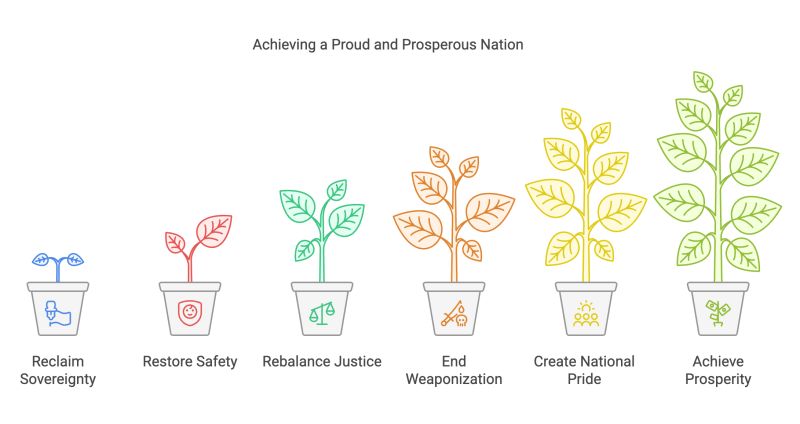
If you're a #lobbyist or #consultant, what can you use AI for when it comes to politics, policy, and public affairs?
Take the transcript of President Trump's inauguration speech yesterday*, and you could do any of the following:
1. Take napkin.ai and turn each paragraph into a visual illustration in a consultancy report (example below)
2. Find the "hidden" messages with this prompt: "Take this transcript and come up with 7 non-obvious insights about the speakers' narrative, priorities, personality, and other insights that can be useful to understand the unspoken messages." (this is pretty cool actually, though anyone following US politics would really not be surprised 😅 here is what ChatGPT came up with: https://lnkd.in/eFZMNd2T)
3. If you're based in the EU, you can have fun and instruct the AI to "Take this transcript and convert it into a short speech adapting the style of Ursula Von der Leyen / Emmanuel Macron / Georgia Meloni / .... [pick one]. Search online for their style before executing the request."
4. Paste the entire transcript and instruct Gemini or ChatGPT to "Read between the lines and deduce all the points that indicate what to expect in regards to [...sector/industry...]" (e.g. "European pharmaceutical industry" : even though the speech is obviously not on concrete policy issues, this prompt still generates interesting insights. It will work much better for other speeches/presentations from senior officials of course.)
Note: these prompts are meant as inspiration as to what political intelligence you can get with a couple of well formulated words. It can be taken to the next level by adding more context, research data or background information. Hope these serve as inspiration to experiment further.
Any other ideas/tips...?
Share them in the comments.
cc Influence Builders
*this is NOT a political post, it's about applied tools & methods
*This was originally posted on Andras Baneth's LinkedIn account.
21 Tips for Effective Writing and Persuasive Communication
At our workshops on communication & persuasion, some tips seem obvious while others are counterintuitive... so I collected 21 of them to share.
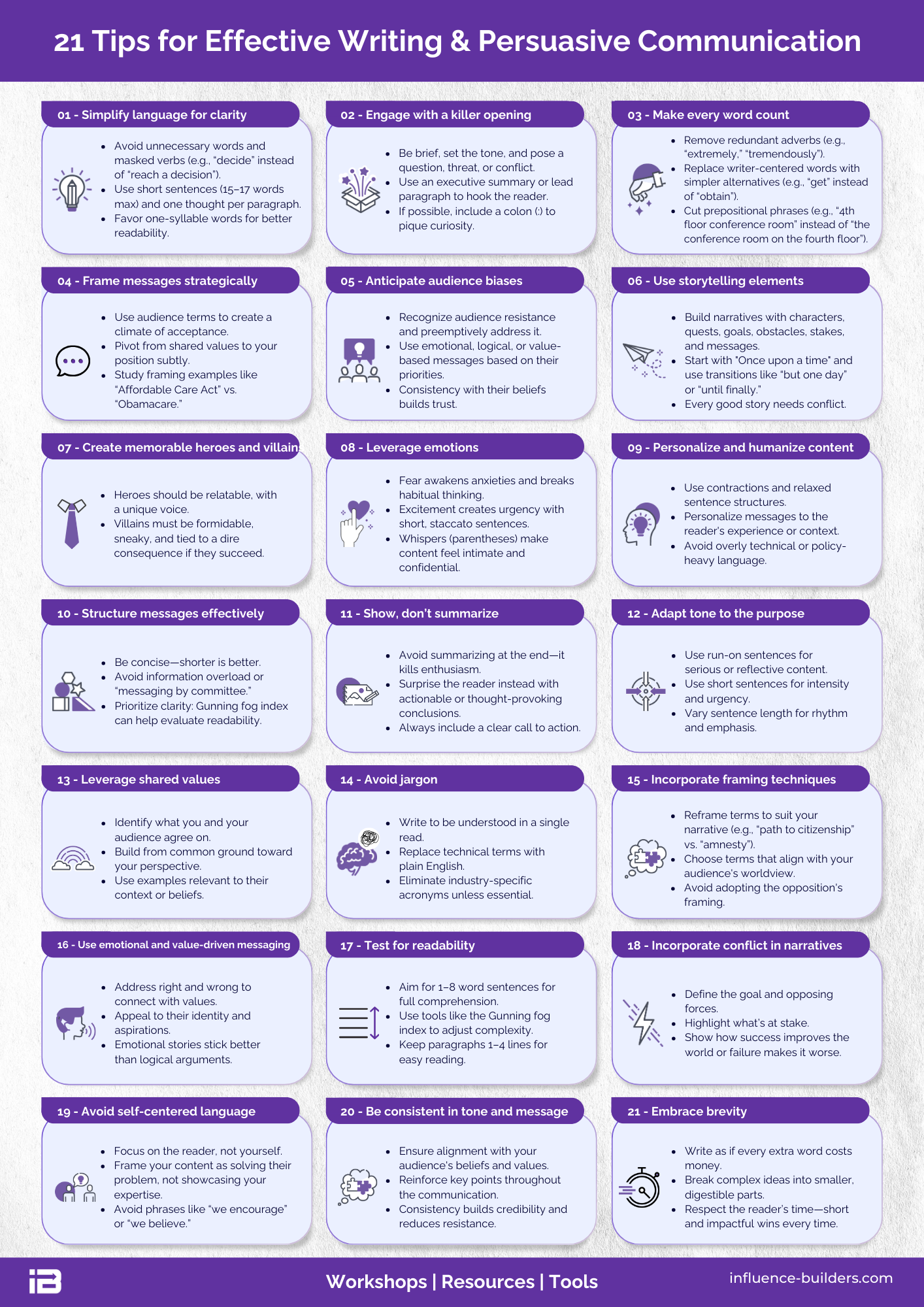
At our workshops on communication & persuasion, some tips seem obvious while others are counterintuitive... so I collected 21 of them to share.
I hope you find the list useful (you can download & print it as PDF) here:
1. Simplify language for clarity.
2. Engage with a killer opening.
3. Make every word count.
4. Frame messages strategically.
5. Anticipate audience biases.
6. Use storytelling elements.
7. Create memorable heroes and villains.
8. Leverage emotions.
9. Personalize and humanize content.
10. Structure messages effectively.
11. Show, don’t summarize.
12. Adapt tone to the purpose.
13. Leverage shared values.
14. Avoid jargon.
15. Incorporate framing techniques.
16. Use emotional and value-driven messaging.
17. Test for readability.
18. Incorporate conflict in narratives.
19. Avoid self-centered language.
20. Be consistent in tone and message.
21. Embrace brevity.
**This was originally posted on Andras Baneth's LinkedIn account.
Yuval Noah Harari's 'Nexus': A Mind Map of AI's Societal Impact and Key Takeaways
Yuval Noah Harari's book "Nexus" is an interesting take on AI's societal impact.
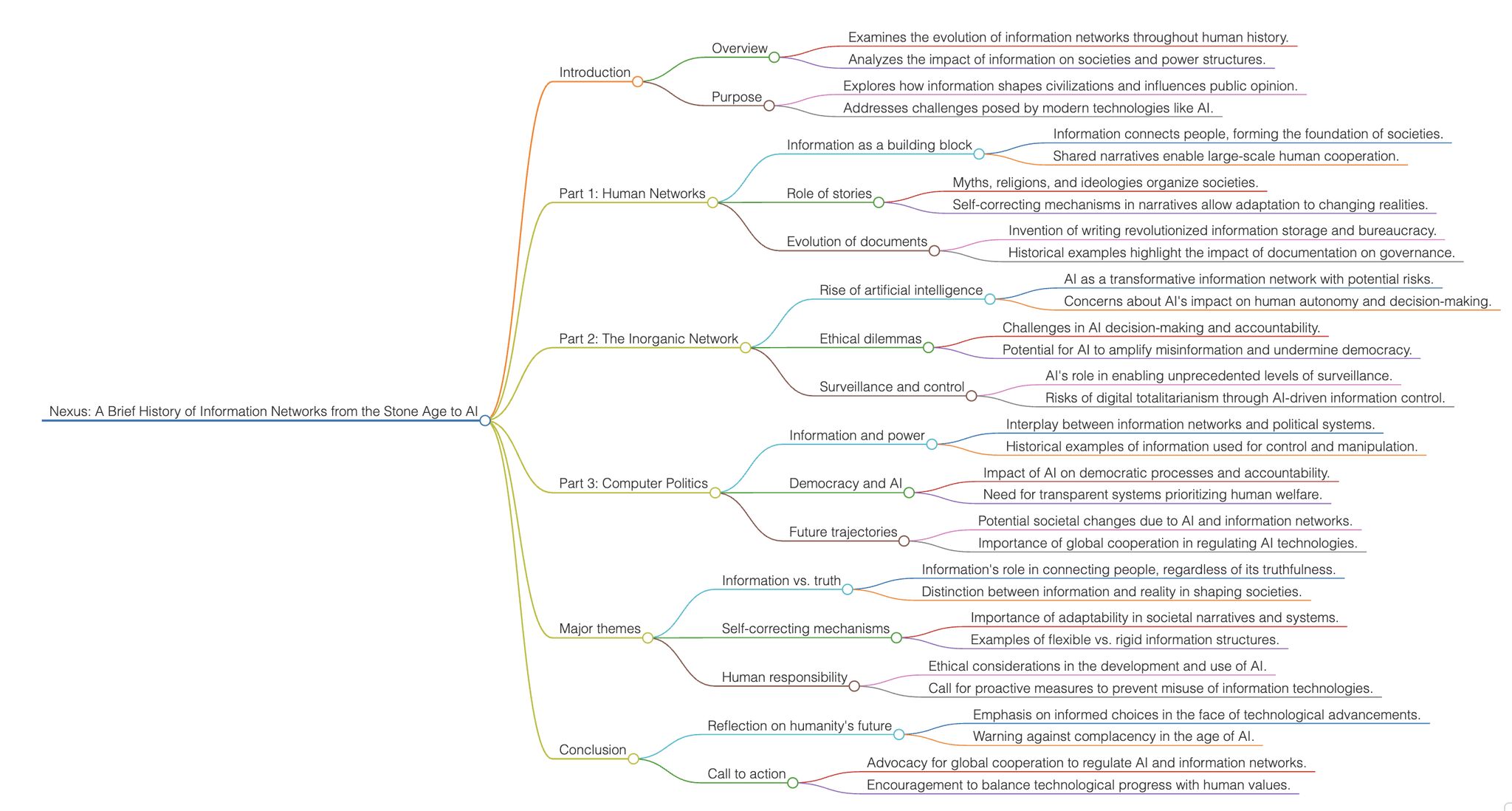
Yuval Noah Harari's book "Nexus" is an interesting take on AI's societal impact. Though there are many smaller items I take issue with (esp. his narrow definition of 'truth'), his big picture approach is a helpful framework to understand what's likely coming.
If you're short on time, here is a mind map version of his key messages.
*This was originally posted on Andras Baneth's LinkedIn account.
Panel on AI Challenges: Data Privacy, Ethics, and Integration – 30 January
Join our (free) panel discussion on 30 January sharing insights on the challenges of using AI.
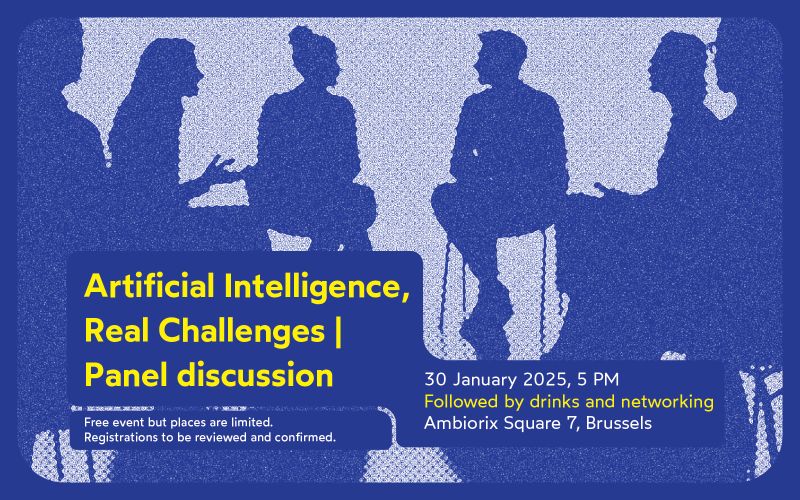
"Artificial intelligence, real challenges": join our (free) panel discussion on 30 January sharing insights on the challenges of using AI:
– Data privacy & business confidentiality
– Ethical considerations, including bias and manipulation
– Integrating AI technologies into existing systems
Featuring Brussels' advocacy and AI experts: Maria Linkova-Nijs, David Timis, and Jacques Foul, moderated by yours truly, co-organised by The Right Street & Influence Builders, hosted by Ambiorix Center.
Registration (subject to confirmation): https://lnkd.in/ezbVDcKM
*This was originally posted on Andras Baneth's LinkedIn account.
Coming Soon: 'The Ultimate EU Handbook' – A Must-Read for EU Enthusiasts
"The Ultimate EU Handbook" is soon coming to a bookshop/library/webstore near you.
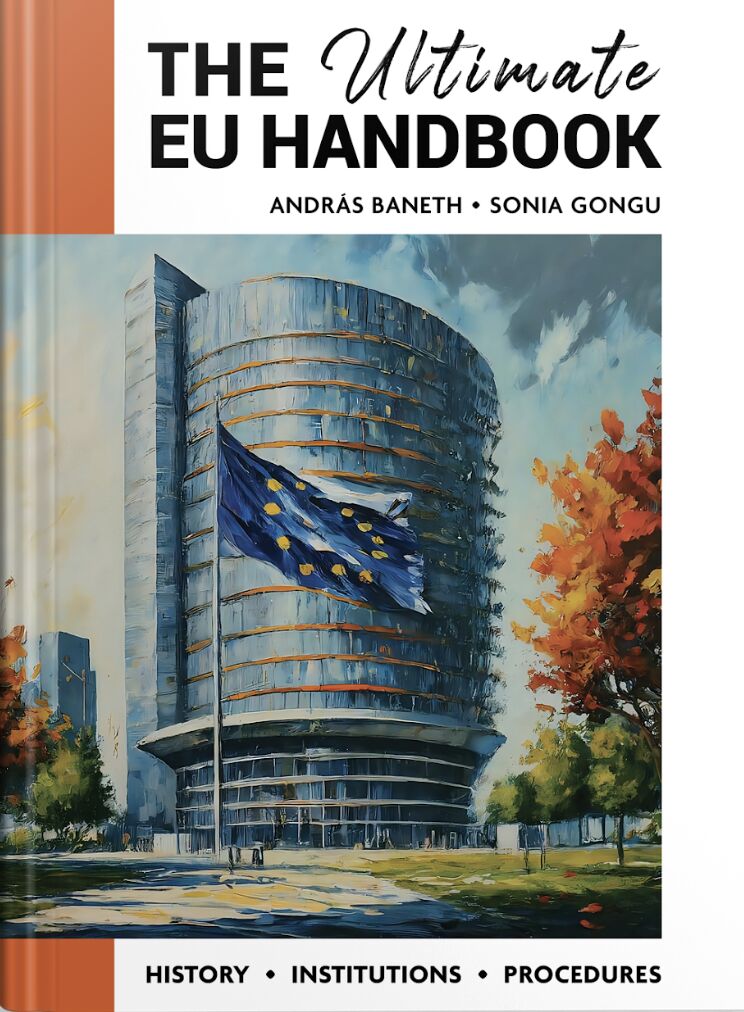
After several months of intense work with Sonia Gongu, John Harper and Ljiljana Pavkov, "The Ultimate EU Handbook" is soon coming to a bookshop/library/webstore near you. Book launch event to be announced soon. Stay tuned 🇪🇺📚
*This was originally posted on Andras Baneth's LinkedIn account.
Essential Tools for EU and US Public Affairs: A Comprehensive Resource
In most EU and/or AI workshops I run, the question 'what tools are out there for EU or US public affairs and advocacy?' comes up.
In most EU and/or AI workshops I run, the question 'what tools are out there for EU or US public affairs and advocacy?' comes up.
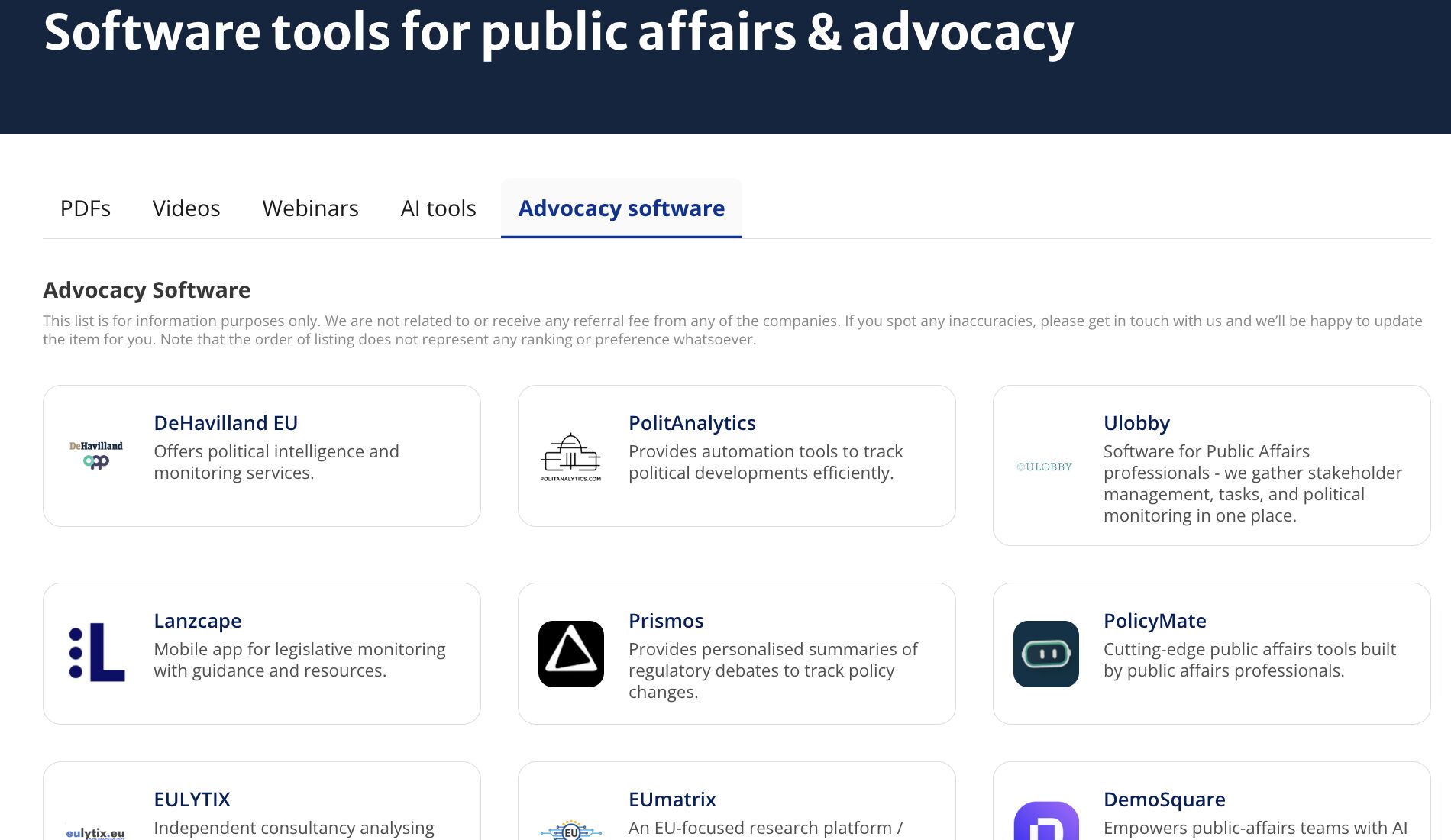
To make it easy, we collected all the software we knew of, on this link: https://www.influence-builders.com/free-res/advocacy-software
This is NOT a ranking or review page, it's simply a collection of the high-quality tools that do one or more of the following:
- legislative tracking
- issue monitoring
- advocacy insights
- policy meeting transcription
- stakeholder mapping
- consultation analysis
...and related tasks that lobbyists, diplomats, and interest representatives can use for their work.
(Some are powered or enhanced by AI, some are not, but AI features were not the primary consideration when selecting a service to be listed.)
Is there any tool missing? Please let me know so we can add it.
If any of the entries need to be updated/refined, let me know as well.
Feel free to share 🤖
p.s.: special thanks to Racquel for the research
*This was originally posted on Andras Baneth's LinkedIn account.
Using AI for Endless Refinement, But Knowing When to Make the Human Call
You can ask hashtag#AI to *anticipate* arguments against your proposal.
You can ask #AI to *anticipate* arguments against your proposal, then give you counter-arguments to those pushbacks, then anticipate counter-counter-arguments, then request counter-counter-counter arguments...ad inifinitum.
You can ask AI for a critical review of your press release, policy paper, briefing, concept note etc. to point out its logical inconsistencies/flaws or that AI plays the devil's advocate on your draft. Then refine your piece based on the feedback and ask AI again to provide points/perspectives you missed so you can patch the gaps. Then do it again and again...ad infinitum.
But at one point, you just have to make a HUMAN decision and call it a day.
*This was originally posted on Andras Baneth's LinkedIn account.
Shipping Risk: Solving Global Threats One Update at a Time
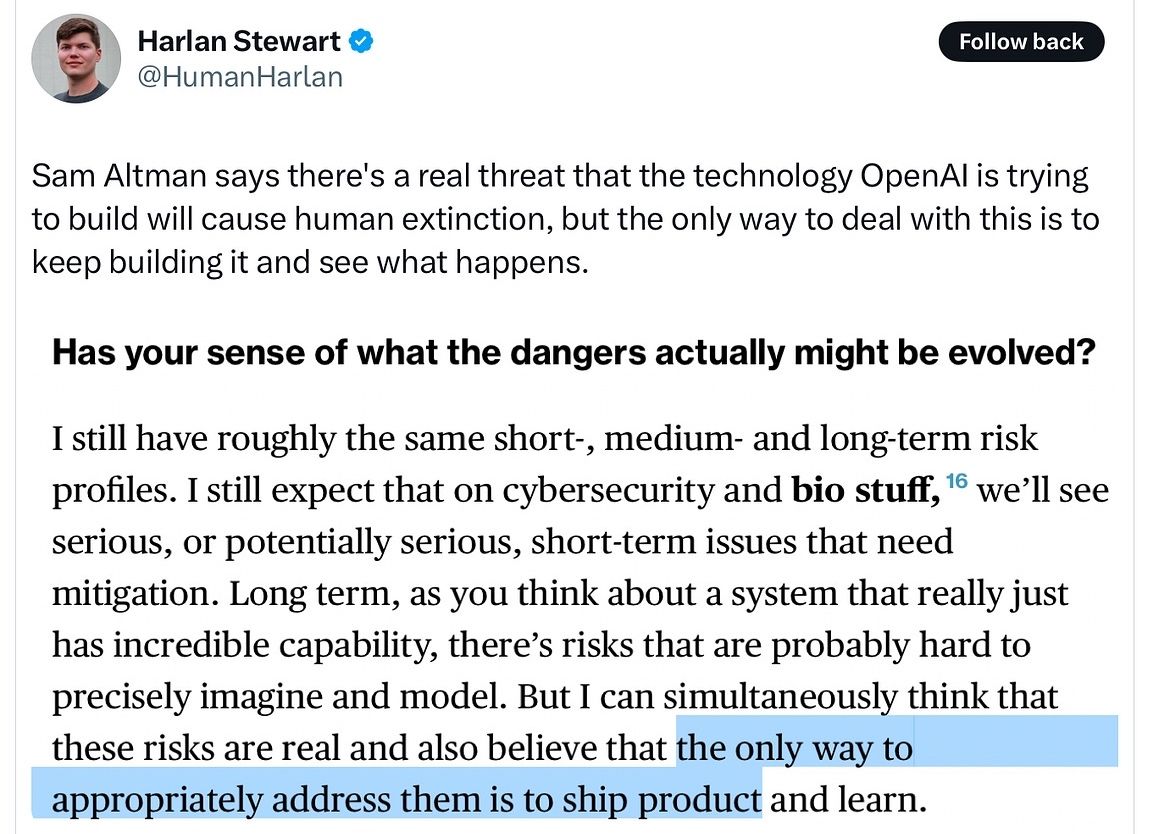
The software might lead to hostile biological weapons, mass unemployment, global war or worse, but we’ll iterate and figure it out in the next upgrade.
The software might lead to hostile biological weapons, mass unemployment, global war or worse, but we’ll iterate and figure it out in the next upgrade.
*This was originally posted on Andras Baneth's LinkedIn account.
Sharpen Your Arguments with DebateAI: A Tool for Persuasion, Not Just Preaching
Lobbyists, NGOs, politicians often broadcast their messages rather than persuade their opponents (aka 'preach to the converted').

Lobbyists, NGOs, politicians often broadcast their messages rather than persuade their opponents (aka 'preach to the converted').
I came across this basic but handy AI tool called debateai.net - it helps you improve your argument, get a pushback, and aim to convince better.
Whether it's pesticides, disinformation regulation, or whether Canada should become the 51st US state, you can test your argumentation skills pro or against.
Sure, it's AI-powered and therefore a bit clichéd/dry at times, but great for practice.
Give it a try and report back 🤓
*This was originally posted on Andras Baneth's LinkedIn account.
Featured articles
and Insights
This compilation takes us through the history of the first #EPSO candidates, showcasing their journey and achievements from the very beginning to the present day—and even looking ahead.
A compilation of the first #EPSO candidates throughout history, until today and beyond.
(Have you played with ChatGPT-4o's new image capabilities? Pretty impressive.)
*This was originally posted on Andras Baneth's LinkedIn account.
Discover the inspiring story behind The Ultimate EU Handbook, a book born from the unexpected connection of a chance pitch and years of creative collaboration.
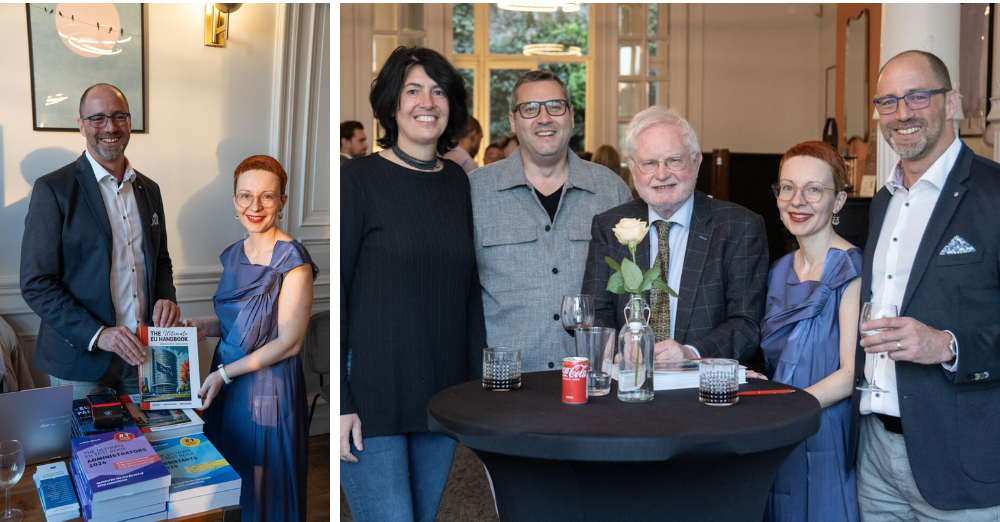
20 years ago, John Harper said 'yes' to an unknown person's unsolicited book pitch, which set of a chain of positive events. Yesterday, another book came to be as a result of two years' intense work and creativity of Sonia Gongu, Martin Tomov, Ljiljana Pavkov... and 'The Ultimate EU Handbook' was born.
Special thanks to Maryana Panyevina, Klym Ahrykov and David Meszaros for your support to make the launch event at Ambiorix Center & Podcast Studio special.
🇪🇺🙏📚
*This was originally posted on Andras Baneth's LinkedIn account.
What began as a discussion about burnout quickly turned into an exploration of something deeper. In my conversation with Dr. Vasadi Anna, a psychiatrist with decades of experience, it became clear that burnout isn’t just about long hours or stress—it’s rooted in expectations, upbringing, and the invisible pressures we internalize from an early age.
English summary of the latest episode of András' Hungarian podcast, 'Lélek Algoritmus – Ilyen az ember (avagy beszélgetések egy pszichiáterrel)' – 'The Soul’s Algorithm: The Human Condition (Conversations with a Psychiatrist).
What began as a discussion about burnout quickly turned into an exploration of something deeper. In my conversation with Dr. Vasadi Anna, a psychiatrist with decades of experience, it became clear that burnout isn’t just about long hours or stress—it’s rooted in expectations, upbringing, and the invisible pressures we internalize from an early age.
Burnout: More Than Just Exhaustion
Burnout gets thrown around a lot, but what does it actually mean? Many assume it’s just extreme fatigue, but as Anna pointed out, it’s something deeper. Burnout drains you emotionally, mentally, and even physically. It’s not the kind of tiredness that a weekend off can fix.
A key distinction Anna made: while depression can affect every part of life, burnout is usually tied to work. But it doesn’t stay there. It spreads—first to colleagues, then to family, then to an overall sense of disillusionment.
The Perfectionist’s Trap
Burnout isn’t just about overworking—it’s about overworking with the wrong mindset. People who push themselves too hard, who never feel their efforts are enough, who equate self-worth with productivity—these are the most at risk.
A common misconception: If I love my work, I can’t burn out. But passion doesn’t shield you. In fact, it often makes things worse. Overcommitting, ignoring personal limits, and relying on caffeine or alcohol to keep up are all red flags.
The Long Shadow of Childhood Expectations
Why do some people burn out while others keep their balance? Often, it starts in childhood.
Many of us grow up believing that our worth is tied to achievement. If we didn’t excel, love and approval felt conditional. Some parents—often unknowingly—reinforce this by setting impossibly high standards or withholding affection when a child falls short. Over time, this creates a need for external validation, making burnout almost inevitable.
Take elite athletes. Their entire identity is wrapped up in performance. When they lose, it’s not just a setback—it feels like a loss of personal value. The same happens in workplaces. A high achiever who misses a promotion doesn’t just feel professional disappointment—they feel like they have failed as a person.
Midlife Crisis: Burnout of the Soul
This naturally led us to midlife crisis, which, in many ways, is burnout playing out on a larger scale.
Both stem from the same root: spending years chasing external markers of success without stopping to ask, Is this what I actually want?
The midlife crisis tends to hit in the 40s or early 50s, often when several pressures collide:
- Aging Parents: The growing responsibility of caring for elderly parents forces many to confront their own mortality.
- Teenage Children: At the same time, kids are becoming more independent, adding another layer of emotional complexity.
- Career Pressures: By midlife, most people have built careers, but many start questioning if they’re on the right path.
It’s a perfect storm of obligations, internal and external, that makes people reevaluate everything—from their job to their marriage to their purpose.
Finding a Way Forward
So, how do we deal with burnout and midlife crisis without making rash decisions?
- Rethink Success – Instead of measuring success by salary, job title, or external validation, define it in terms of fulfillment and balance. If your work is draining you, can it really be called success?
- Recognize the Warning Signs – Losing interest in work, feeling detached, and struggling to muster enthusiasm are all early signs of burnout.
- Set Boundaries – Work will always demand more. It’s up to you to decide what is enough.
- Address Deep-Seated Patterns – If your self-worth depends on achievement, it might be time to rethink where that belief came from. Therapy and self-reflection can help break the cycle.
- Embrace Change – A midlife crisis isn’t necessarily a crisis—it can be a wake-up call. Maybe it’s time for a career shift, a realignment of priorities, or simply a different perspective.
Final Thoughts
Burnout and midlife crisis aren’t just work problems or age-related phases. They’re signals—urgent ones—telling us that something needs to change. The real question isn’t How do I push through? but Am I living a life that actually fits me?
If the answer is no, maybe the crisis isn’t a disaster. Maybe it’s an opportunity.