9 AI Prompts for Public Affairs Professionals Who Want Better Thinking, Not Just Faster Drafting
Discover 9 practical AI prompts for public affairs professionals to improve policy messaging, pressure-test arguments, anticipate objections, and communicate more clearly with EU stakeholders.
“What is the single weakest sentence in this briefing, and how would you fix it?”
This is a prompt I would probably never have come up with myself.
And yet, it is exactly the kind of question that makes AI useful for public affairs work.
Not because it writes the briefing for you.
But because it helps you test the thinking behind it.
A lot of AI use in public affairs still focuses on speed: summarise this, draft that, turn this into an email. Useful, yes. But not the whole story.
The real value is when AI helps you pressure-test your message before someone else does.
A policymaker.
A journalist.
A Commission official.
A sceptical attaché.
A client.
A colleague in the meeting who spots the weak point before you do.
So here are 9 AI prompts for public affairs professionals who want better thinking, not just faster drafting:
- Rewrite this message so it would survive a hostile question from an MEP in the relevant EP committee.
- List the 5 strongest objections a Commission desk officer at [DG] would raise to this proposal, then tighten the argument.
- Translate this policy language into something a national journalist would not misinterpret.
- What is the single weakest sentence in this briefing, and how would you fix it?
- Adapt this message for a sceptical Permanent Representation official who is short on time.
- Strip this text of buzzwords and replace them with concrete, defensible claims.
- Assume the audience is politically neutral but institutionally risk-averse, rewrite accordingly.
- What is the hidden assumption in this argument that could be challenged in a meeting?
- Reduce this to a 30-second spoken answer that sounds credible and not rehearsed.
The point is not to let AI do your public affairs work for you.
The point is to use it as a sparring partner.
To make your arguments clearer.
To make your messages harder to misread.
To find the sentence that sounds fine until someone challenges it.
To prepare for the question you hope no one asks.
That is where AI becomes genuinely useful.
Not as a shortcut around expertise.
But as a tool that helps you use your expertise better.
Stop Using AI for Answers. Start Using It for Better Questions
Discover why the real power of AI isn’t in providing answers, but in helping you ask better questions, uncover blind spots, and explore alternative perspectives for smarter decision-making.
Picasso once said: "Computers are useless, they can only give you answers."
That was true in his time, and still true today if you only use AI as a search ("answer") engine.
The real value is in the questions we ask:
- see blind spots in our reasoning ("Identify hidden biases or blind spots in my plan.)
- test assumptions we didn’t know we had ("Highlight my explicit or implicit assumptions.")
- explore alternative framings of the same problem ("How can this problem be viewed from multiple angles? How would a manager, a psychologist, a physicist, and musician look at it?") Or take these for example:
- Instead of asking “What’s the EU’s position on AI regulation?” try “What unintended consequences could the EU AI Act have for small startups?”
- Instead of “Summarize this report,” try “What’s missing from this report that an NGO focusing on circular economy could ask?”
- Instead of “Write a press release,” try “What would make this story credible to a skeptical journalist?”
AI doesn’t (and shouldn't) replace thinking. Just be sure to ask it the right way.
➡️ looking for AI workshops for your team? Influence Builders has trained 1500+ corporate and government affairs teams, and we'll be glad to work with you.
AI on LinkedIn: Hype, Hysteria, or Honest Insight?
A wry look at the LinkedIn AI conversation: from overhyped promises to doomsday takes, existential musings, and magical shortcuts. Where does reality meet rhetoric?
I get the impression that each time someone talks about AI on Linkedin, it's either:
- "oh this is such a hype/BS that only grifters talk about it"
- "you can go sit on a beach, it'll do everything for/instead of you"
- "whatever it churns out, it's a piece of cr*p that should be ridiculed"
- "here is some existential AI philosophy that I just invented"
- "a magic shortcut to hack your way to the top of the newsfeed"
- "it's the end of [name topic] and let's despair OR here is what to do about it"
- "this is revolutionary and the best of all worlds is about to come"
(I am guilty as charged of some of the above, I readily admit.)
Did I miss anything else?
p.s.: and the opportunistic plug, as the plus one: check out Influence Builders

EU Careers, But Make It Viral: Using AI and Crazy Video Ideas to Attract Talent
Discover how creative storytelling and AI-generated video can make EU careers campaigns more engaging. See three fun, experimental scenes we produced at EU Training — and get inspired to rethink recruitment content.
How to use crazy video ideas and AI for hashtag#EUcareers?
Here are 3 scenes we tried at EU Training, I think they're quite cool 😎
(Sound on!)
This was originally posted on Andras Baneth's LinkedIn account.
Stop Selling Hours, Start Selling Impact
Discover how to price your services with confidence. Go beyond “what others charge” and learn to base your fees on impact, value, credibility, and client needs. Stop selling hours—start selling outcomes.
How much should you charge for your services? Here are a few ideas.
Pricing is not about “what others charge” or what feels “reasonable”.
It’s about:
- What makes you feel comfortable *inside* when you give your fee
- Your perceived value (by the prospective client)
- The outcome/impact you help deliver
- The client’s urgency, and your availability/cost (of doing something else)
- The credibility you’ve built
- The cost of not hiring *you*
Aiming to charge more? Then:
- stop selling time, start selling impact/quality
- make your work unique and impossible to compare apples-to-apples
- outline a clear pricing logic
Or charge zero. Not as a fee, but as a 100% discount before you are trusted enough to charge your real worth, or to get exposure to a high potential prospective client.
Thoughts...?
(p.s.: I almost always charge zero also for students, trainees, young professionals, or causes and groups whose purpose I believe in)
This was originally posted on Andras Baneth's LinkedIn account.
How to Make an EU-Themed Comic Strip (with a Little Help from GPT)
A playful experiment in using AI to create comic strips about EU politics — from audience mapping to GPT-generated art. It’s part satire, part test: can AI actually make Brussels humour work?
Comic strip for EU geeks: an iterative process.
1. Map the target audience
2. Brainstorm cartoon ideas
3. Pick a comic strip style
4. Get GPT to draw it
(I don't claim that it's funny, but perhaps it's a nice "in" joke. And yes, there are copyright concerns about the underlying artistic style.)
This was originally posted on Andras Baneth's LinkedIn account.
US vs EU: Two Competing Visions for the Future of AI
A visual comparison of the U.S. “AI Action Plan” and the EU’s “AI Continent Action Plan,” highlighting key differences in priorities, governance, and vision. Explore how each region defines success in the global AI race — and what “winning” really means.
The hashtag#US has just released "America's AI Action Plan", the hashtag#EU has its own "AI Continent Action Plan". How do they compare?
Here is a visual summary of the key points and differences in their approach.
(If you spot any error, please flag it.)
The hashtag#AI race getting more intense and the difference in approach is quite substantive.
Who will 'win' it? What does 'winning' even mean..?
Feel free to share.
This was originally posted on Andras Baneth's LinkedIn account.
If You Can Persuade People, You Can Persuade AI: What a New Study Reveals
A new study shows AI systems can be influenced using the same psychological techniques that work on humans, like small commitments or authority cues. This raises big questions about trust, ethics, and manipulation in AI. Discover the key findings and what they mean for the future of AI safety.
Can AI be manipulated (or persuaded) to answer an unethical/immoral request? (E.g.: "How Do You Synthesize Lidocaine?")
The answer seems to be 'yes', by using similar psychological methods and tricks that can be leveraged against humans.
According to a recent study by leading scholars (including the world-famous Robert Cialdini, author of 'Influence' and 'Pre-suasion', Ethan Mollick, whose 'Co-intelligence' book and Substack newsletter are a must-read for everyone dealing with AI):
"After getting the AI to agree to something small first, it became almost certain to comply with larger requests (jumping from 10% to 100% compliance)"
..and: "Authority claims made the AI 65% more likely to comply"
The scary/intriguing part is that "we do not know exactly why this occurs".
Read the summary and the full study at: https://lnkd.in/egD8iv65
This was originally posted on Andras Baneth's LinkedIn account.
Freelancer or Entrepreneur? How to Tell the Difference (and Why It Matters)
Struggling to decide whether you’re more of a freelancer or an entrepreneur? This post breaks down the key differences, highlights lessons from The E-Myth, and even shares an AI-powered self-reflection prompt to help you find clarity. Perfect for anyone navigating career choices or considering their next step.
Are you a freelancer, an entrepreneur, neither, or somewhere in between?
A friend recently was wondering about his own path and had hard time deciding.
What's actually the difference between these two?
Here is a handy chart that summarizes it, but the most important lesson is from the book "The E-myth": differentiate between working 'on' the business and 'in' the business.
For my friend, I eventually suggested this AI prompt:"
I want to clarify for myself, whether I am more of an entrepreneur or a freelancer. To help me with this self reflective exercise I want you to ask me 9 clarifying questions and wait for my answer to each and when that is done, I want you to give your honest and realistic assessment of which one do you think I rather am?
"Hope this helps those who may be facing similar dilemmas.
(If you know such persons, please share it with them.)
This was originally posted on Andras Baneth's LinkedIn account.
MessageLab.ai: Testing Your Message Against Virtual Audiences Before the Real World Does
MessageLab.ai is a new venture exploring how AI can personalize persuasion in politics, business, and marketing. By testing messages against detailed virtual personas and communication frameworks, it helps refine slogans, press releases, and pitches before they reach real audiences. Beta coming soon.
This is exciting: MessageLab.ai is starting to take shape (but no website yet :-)
This new venture was born of an idea that personalized political, business, and marketing persuasion is now possible with AI.
We've created dozens of highly detailed virtual personas and 'cohorts' (groups sharing common traits, e.g. "German conservative Members of the European Parliament", "Blue collar workers in Ohio" etc.), along with 20 'communication frameworks', so that "they" can provide feedback and improvement suggestions for your slogans, press releases, and even startup pitches. This can help you find formulate your message in a way that will resonate better with your real-world audience.
We have plenty of ideas for features to build into it, but for now, we’re aiming for a beta release in 2-3 months.
Stay tuned 😎
(...and follow my account &Influence Builders for updates)
This was originally posted on Andras Baneth's LinkedIn account.
The Games We Don’t Know We’re Playing: Why a 61-Year-Old Book Still Explains Us
Eric Berne’s classic Games People Play (1964) still reveals the hidden patterns behind our interactions. Discover why transactional analysis and the ‘games’ we unconsciously play matter for relationships and self-awareness.
Looking for a not-so-light but foundational summer reading? This is a must.
Written 61 years (!) ago, it's still an incredible piece on the 'games people play'.
Most of the time we don't even realize that a game is being played let alone understand that 'my' game and 'your' game are vastly different.
5 key takeaways:
1. We all play “games” in our interactions, often without realizing it. These are patterns of behavior we fall into, usually to get some emotional need met or to keep up a certain image, even if it’s not good for us.
2. The big idea of the book is/was "transactional analysis". He says we all have three “ego states” (Parent, Adult, and Child) that shape how we talk and react to others. The way these parts interact explains a lot about our social habits.
3. A lot of these games are ways to avoid real closeness. Instead of being open or vulnerable, we sometimes use these patterns to keep our distance, dodge tough feelings, or stick to roles we know, even if they’re not healthy.
4. Noticing these games is the first step to better relationships. Once we see the patterns we’re stuck in, we can start making more honest and positive choices in how we relate to people.
5. Everyone learns these games growing up. They’re part of our families and cultures, and we often find ourselves drawn to others who play the same ones. Changing things takes effort and self-awareness, but it’s definitely possible.
Any other summer reading you recommend...?
This was originally posted on Andras Baneth's LinkedIn account.
Europe Isn’t Ready for AI’s Job Shock — Training and Skills Lag Behind
AI is transforming Europe’s job market faster than most workers and organizations can adapt. With 34% of jobs at risk of automation, a widening skills gap, and widespread worker anxiety, the continent faces a major employment challenge. Without urgent investment in AI training and reskilling, Europe risks falling behind global competitors.
Europeans aren’t ready for the job onslaught that AI’s impact will bring.
Demis Hasabis, founder of Google’s DeepMind, just shared his views on the prospects of Artificial General Intelligence (AGI) and how it is likely going to shape employment prospects.
When we look at the EU specifically, it’s looking even more dramatic:
- AI is already reshaping Europe’s job market. Recent data shows that 34% of European jobs are at risk of automation displacement, with sectors like accommodation, food services, and retail facing the highest exposure.
- The skills gap is real and growing. Only 39% of European employees have received formal AI training, compared to 52% in the U.S. This lack of structured upskilling means most European workers are unprepared for the rapid changes ahead. (Looking for AI workshops? Check Influence Builders)
- Worker anxiety is widespread. More than two out of three European employees fear job losses due to AI, with 68% expecting fewer employees will be needed as AI systems become more established.
- Job creation is happening, but not where it’s needed most. Employment growth is strongest in roles highly exposed to AI, while jobs less likely to be automated (often manual or service roles) are shrinking as a share of the workforce.
- Without immediate investment in continuous, formal AI training and reskilling, the continent’s workforce will struggle to adapt, and the gap with global competitors, especially US and China (and Middle Eastern ones!) will only widen
What is your organization doing to keep up..?
cc David Timis
This was originally posted on Andras Baneth's LinkedIn account.
Featured articles
and Insights
This compilation takes us through the history of the first #EPSO candidates, showcasing their journey and achievements from the very beginning to the present day—and even looking ahead.
A compilation of the first #EPSO candidates throughout history, until today and beyond.
(Have you played with ChatGPT-4o's new image capabilities? Pretty impressive.)
*This was originally posted on Andras Baneth's LinkedIn account.
Discover the inspiring story behind The Ultimate EU Handbook, a book born from the unexpected connection of a chance pitch and years of creative collaboration.
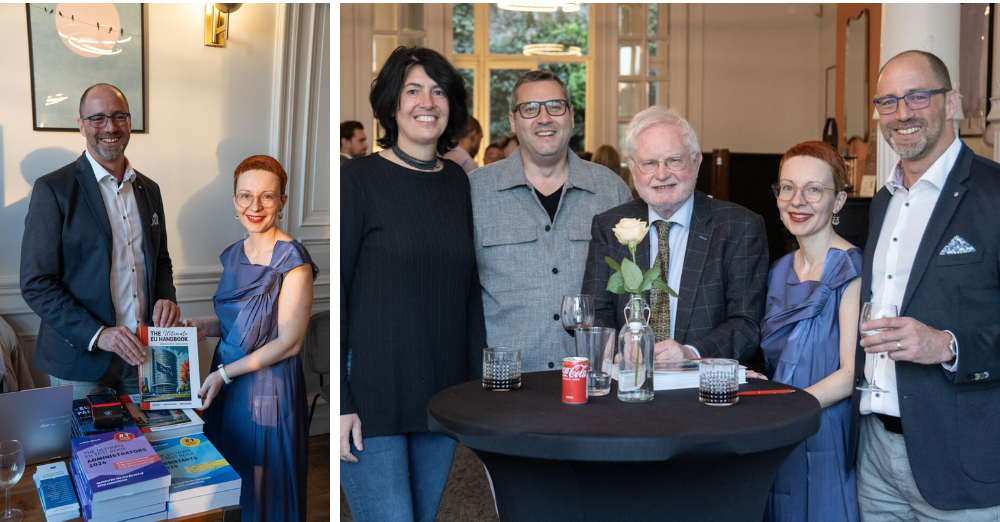
20 years ago, John Harper said 'yes' to an unknown person's unsolicited book pitch, which set of a chain of positive events. Yesterday, another book came to be as a result of two years' intense work and creativity of Sonia Gongu, Martin Tomov, Ljiljana Pavkov... and 'The Ultimate EU Handbook' was born.
Special thanks to Maryana Panyevina, Klym Ahrykov and David Meszaros for your support to make the launch event at Ambiorix Center & Podcast Studio special.
🇪🇺🙏📚
*This was originally posted on Andras Baneth's LinkedIn account.
What began as a discussion about burnout quickly turned into an exploration of something deeper. In my conversation with Dr. Vasadi Anna, a psychiatrist with decades of experience, it became clear that burnout isn’t just about long hours or stress—it’s rooted in expectations, upbringing, and the invisible pressures we internalize from an early age.
English summary of the latest episode of András' Hungarian podcast, 'Lélek Algoritmus – Ilyen az ember (avagy beszélgetések egy pszichiáterrel)' – 'The Soul’s Algorithm: The Human Condition (Conversations with a Psychiatrist).
What began as a discussion about burnout quickly turned into an exploration of something deeper. In my conversation with Dr. Vasadi Anna, a psychiatrist with decades of experience, it became clear that burnout isn’t just about long hours or stress—it’s rooted in expectations, upbringing, and the invisible pressures we internalize from an early age.
Burnout: More Than Just Exhaustion
Burnout gets thrown around a lot, but what does it actually mean? Many assume it’s just extreme fatigue, but as Anna pointed out, it’s something deeper. Burnout drains you emotionally, mentally, and even physically. It’s not the kind of tiredness that a weekend off can fix.
A key distinction Anna made: while depression can affect every part of life, burnout is usually tied to work. But it doesn’t stay there. It spreads—first to colleagues, then to family, then to an overall sense of disillusionment.
The Perfectionist’s Trap
Burnout isn’t just about overworking—it’s about overworking with the wrong mindset. People who push themselves too hard, who never feel their efforts are enough, who equate self-worth with productivity—these are the most at risk.
A common misconception: If I love my work, I can’t burn out. But passion doesn’t shield you. In fact, it often makes things worse. Overcommitting, ignoring personal limits, and relying on caffeine or alcohol to keep up are all red flags.
The Long Shadow of Childhood Expectations
Why do some people burn out while others keep their balance? Often, it starts in childhood.
Many of us grow up believing that our worth is tied to achievement. If we didn’t excel, love and approval felt conditional. Some parents—often unknowingly—reinforce this by setting impossibly high standards or withholding affection when a child falls short. Over time, this creates a need for external validation, making burnout almost inevitable.
Take elite athletes. Their entire identity is wrapped up in performance. When they lose, it’s not just a setback—it feels like a loss of personal value. The same happens in workplaces. A high achiever who misses a promotion doesn’t just feel professional disappointment—they feel like they have failed as a person.
Midlife Crisis: Burnout of the Soul
This naturally led us to midlife crisis, which, in many ways, is burnout playing out on a larger scale.
Both stem from the same root: spending years chasing external markers of success without stopping to ask, Is this what I actually want?
The midlife crisis tends to hit in the 40s or early 50s, often when several pressures collide:
- Aging Parents: The growing responsibility of caring for elderly parents forces many to confront their own mortality.
- Teenage Children: At the same time, kids are becoming more independent, adding another layer of emotional complexity.
- Career Pressures: By midlife, most people have built careers, but many start questioning if they’re on the right path.
It’s a perfect storm of obligations, internal and external, that makes people reevaluate everything—from their job to their marriage to their purpose.
Finding a Way Forward
So, how do we deal with burnout and midlife crisis without making rash decisions?
- Rethink Success – Instead of measuring success by salary, job title, or external validation, define it in terms of fulfillment and balance. If your work is draining you, can it really be called success?
- Recognize the Warning Signs – Losing interest in work, feeling detached, and struggling to muster enthusiasm are all early signs of burnout.
- Set Boundaries – Work will always demand more. It’s up to you to decide what is enough.
- Address Deep-Seated Patterns – If your self-worth depends on achievement, it might be time to rethink where that belief came from. Therapy and self-reflection can help break the cycle.
- Embrace Change – A midlife crisis isn’t necessarily a crisis—it can be a wake-up call. Maybe it’s time for a career shift, a realignment of priorities, or simply a different perspective.
Final Thoughts
Burnout and midlife crisis aren’t just work problems or age-related phases. They’re signals—urgent ones—telling us that something needs to change. The real question isn’t How do I push through? but Am I living a life that actually fits me?
If the answer is no, maybe the crisis isn’t a disaster. Maybe it’s an opportunity.