9 AI Prompts for Public Affairs Professionals Who Want Better Thinking, Not Just Faster Drafting
Discover 9 practical AI prompts for public affairs professionals to improve policy messaging, pressure-test arguments, anticipate objections, and communicate more clearly with EU stakeholders.
“What is the single weakest sentence in this briefing, and how would you fix it?”
This is a prompt I would probably never have come up with myself.
And yet, it is exactly the kind of question that makes AI useful for public affairs work.
Not because it writes the briefing for you.
But because it helps you test the thinking behind it.
A lot of AI use in public affairs still focuses on speed: summarise this, draft that, turn this into an email. Useful, yes. But not the whole story.
The real value is when AI helps you pressure-test your message before someone else does.
A policymaker.
A journalist.
A Commission official.
A sceptical attaché.
A client.
A colleague in the meeting who spots the weak point before you do.
So here are 9 AI prompts for public affairs professionals who want better thinking, not just faster drafting:
- Rewrite this message so it would survive a hostile question from an MEP in the relevant EP committee.
- List the 5 strongest objections a Commission desk officer at [DG] would raise to this proposal, then tighten the argument.
- Translate this policy language into something a national journalist would not misinterpret.
- What is the single weakest sentence in this briefing, and how would you fix it?
- Adapt this message for a sceptical Permanent Representation official who is short on time.
- Strip this text of buzzwords and replace them with concrete, defensible claims.
- Assume the audience is politically neutral but institutionally risk-averse, rewrite accordingly.
- What is the hidden assumption in this argument that could be challenged in a meeting?
- Reduce this to a 30-second spoken answer that sounds credible and not rehearsed.
The point is not to let AI do your public affairs work for you.
The point is to use it as a sparring partner.
To make your arguments clearer.
To make your messages harder to misread.
To find the sentence that sounds fine until someone challenges it.
To prepare for the question you hope no one asks.
That is where AI becomes genuinely useful.
Not as a shortcut around expertise.
But as a tool that helps you use your expertise better.
Stop Using AI for Answers. Start Using It for Better Questions
Discover why the real power of AI isn’t in providing answers, but in helping you ask better questions, uncover blind spots, and explore alternative perspectives for smarter decision-making.
Picasso once said: "Computers are useless, they can only give you answers."
That was true in his time, and still true today if you only use AI as a search ("answer") engine.
The real value is in the questions we ask:
- see blind spots in our reasoning ("Identify hidden biases or blind spots in my plan.)
- test assumptions we didn’t know we had ("Highlight my explicit or implicit assumptions.")
- explore alternative framings of the same problem ("How can this problem be viewed from multiple angles? How would a manager, a psychologist, a physicist, and musician look at it?") Or take these for example:
- Instead of asking “What’s the EU’s position on AI regulation?” try “What unintended consequences could the EU AI Act have for small startups?”
- Instead of “Summarize this report,” try “What’s missing from this report that an NGO focusing on circular economy could ask?”
- Instead of “Write a press release,” try “What would make this story credible to a skeptical journalist?”
AI doesn’t (and shouldn't) replace thinking. Just be sure to ask it the right way.
➡️ looking for AI workshops for your team? Influence Builders has trained 1500+ corporate and government affairs teams, and we'll be glad to work with you.
AI on LinkedIn: Hype, Hysteria, or Honest Insight?
A wry look at the LinkedIn AI conversation: from overhyped promises to doomsday takes, existential musings, and magical shortcuts. Where does reality meet rhetoric?
I get the impression that each time someone talks about AI on Linkedin, it's either:
- "oh this is such a hype/BS that only grifters talk about it"
- "you can go sit on a beach, it'll do everything for/instead of you"
- "whatever it churns out, it's a piece of cr*p that should be ridiculed"
- "here is some existential AI philosophy that I just invented"
- "a magic shortcut to hack your way to the top of the newsfeed"
- "it's the end of [name topic] and let's despair OR here is what to do about it"
- "this is revolutionary and the best of all worlds is about to come"
(I am guilty as charged of some of the above, I readily admit.)
Did I miss anything else?
p.s.: and the opportunistic plug, as the plus one: check out Influence Builders

The Rise of Digital Advocacy in the EU
How do I know if my communication efforts are going to pay off, in terms of time and effort invested?
“I don’t see myself as a lobbyist on EU regulations. I consider my job as a corporate diplomat, someone who needs to shape the discussion on the big environmental topics”, said a senior Brussels representative of an energy technology company the other day.
Those who work in sales have a fairly specific goal: sell more products.
In public affairs, however, there is a tougher challenge:
the “product” being sold is concepts, technologies and strategic plans.
In short: ideas, to gain influence.
The question most commonly asked here is, “how do I know if my communication efforts are going to pay off, in terms of time and effort invested?”
The tech world loves to boast of its data-driven mindset by saying “data beats opinion”.
Politics, and its corollary, public affairs, has for too long been a soft art where subjective impressions, small sample sizes and personal contacts drove the analysis. It was hard to imagine, until very recently, how public social networks and information analytics could apply to European affairs or politics.
No more: with the rise of software apps that aid understanding of mass-scale online discussions, communication experts can easily find the most influential journalists, bloggers or activists to pitch their story to, rather than distributing a one-size-fits-all press release.
Experts can now target their activities,
such as looking at data from the European Parliament and the Council
to decide which politician and MEP they want to engage with,
based on their voting patterns.
Political intelligence is a fascinating use case, but is far from the only one in the digital advocacy toolkit.
“I started using Twitter almost exclusively for advocacy purposes, and our efforts didn’t stop there. We’ve produced a few video interviews and discussions with MEPs and Commissioners, which gained traction with the right audience. That led to us being taken more seriously, getting invited to background briefings, and advancing our access and influence”, said the expert quoted above.
According to the Digital Advocacy Trends in 2015 survey, the top two goals of the mainly Brussels, London and Paris-based respondents was to promote their organisation’s views and to engage better with policy makers.
They claimed to achieve this by using social media and strategies like sharing infographics, sending out newsletters or producing videos. Over three quarters of the respondents expect their digital advocacy spending to increase in 2016.
There is no denying that the biggest change in advocacy practices
in the past 5-10 years has arisen from the growth
in the importance and pervasiveness of digital communications.
New skills need to be learned. New measuring techniques and analysis tools need to be developed. To recognise this growing interest, the Public Affairs Council is organising the 2nd edition of the Digital Advocacy Summit in Brussels on 21 October.
(the original of this article appeared on EUobserver.com on 7 Oct 2015)
EUobserver: 'EU-funded lobbyists - why do they exist?'
The European Commission, most recently its DG Environment, has just released a report on the latest round of funding for "European environmental NGOs".
The European Commission, most recently its DG Environment, has just released a report on the latest round of funding for "European environmental NGOs".
But think about it: Why does the EU's executive need to give taxpayers' money to any activist group at all?
Make no mistake: all NGOs, private businesses and citizens must be heard to make their case in the policy-making process and it's up to the EU institutions to work out the policy they want to adopt.
The question, however, is about funding. Even if you support the idea of "government-funded non-governmental organisations", on what basis does the European Commission decide which NGO to give money to, or whether to fund an NGO over a private business because it speaks from a "moral" standpoint?
Such funding restrictions should affect NGOs that fall under the scope of the Joint Transparency Register and whose primary activity is advocacy.
EU funded EU lobbyism
There is a strong case to give public support to civil society organisations involved in EU enlargement, development policies or scientific discussions, but funding activist groups whose primary, and sometimes only, mission is to lobby EU policy makers and stakeholders is not justified.
Similarly, while private companies get public money for research, infrastructure or consulting works, they would never be given funding for their lobby activity.
The European Commission is often accused of lacking democratic legitimacy. As a result, it tries to compensate by giving grants and a megaphone to certain groups who claim to speak "on behalf of [European] citzens".
But when did I, as a European citizen, ask these groups to speak on my behalf?
At the heart of this approach is a flawed belief that business groups are too powerful, have unlimited budgets and skew the decision-making to the detriment of the under-staffed, under-sourced "public interest" NGOs.
The "input metrics" measured by Transparency International, i.e. the number of meetings with senior officials, will always show that the corporate world has lobbied heavily and civil society is underrepresented.
Business less successful
Why not rather look at the outcome or the impact of those meetings?
Not many studies have been done on this topic, but one that surely stands out is a two-year long Intereuro research, published on the London School of Economics blog, showing that "business actors are less successful than citizen groups at lobbying EU legislators".
Moreover, it's nonsense to label NGOs "right" because of the public interest they claim to represent, and private interests "wrong" simply because of their partiality or "profit motive".
Private companies create jobs, spend on innovation, pay a significant amount of taxes - all of which are "public interests" after all.
There is no rationale for financing issue-advocacy NGOs that lobby the very same European institutions that give them money.
It's undemocratic and skews the policy debate, often to the detriment of the real representatives of the public good.
TTIP: Winning the regulatory battle, losing the communications war
Debate on major policy issues is not about black and white arguments where the “true” one wins.

Debate on major policy issues is not about black and white arguments where the “true” one wins. Discuss food safety or the quality of democracy and there will be strong views on each side.
The art of persuasion blends with the art of political campaigning. It’s frustrating to see how most supporters of the Transatlantic Trade and Investment Partnership (TTIP), the free trade agreement and regulatory cooperation between the EU and the US, forget this.
TTIP itself is no small issue: it has the potential to increase GDP on both sides of the Atlantic by 0.5%, create hundreds of thousands of jobs and make the transatlantic alliance a global standard-setter for chemicals, cars, air quality and so much more. A neat idea. But as things stand it will die before it’s born.
In the anti-free trade camp, a campaign group has created a populistic yet highly visual and easy-to-understand video featuring well-tested fear buttons (chlorine chicken, states overruled by shady courts etc.)
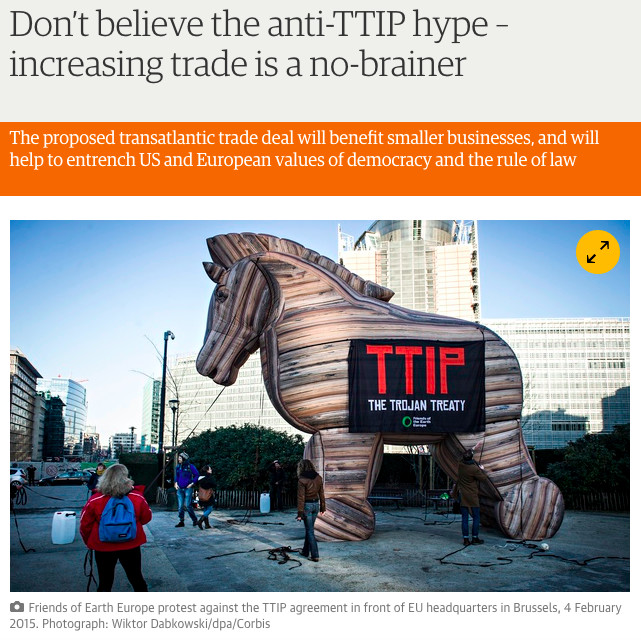
On the pro side, European Commissioners have written in The Guardian that “[t]he European Commission that took office at the beginning of November has two overriding priorities: jobs and growth. In pursuit of those goals, increased trade is a no-brainer.” You can read that as “how dare you not support our goals”. How exactly will this win over the undecided, let alone opponents?
Increasing outreach and multiplying the channels through which the Commission, private companies, institutions or individuals who support TTIP, speak, will not do the trick. What might though, is when the content and quality of the messages are radically rethought.
Advocating for, or campaigning against free trade is an important part of anyone’s identity and political conviction. Therefore rational, cold and distant arguments like GDP growth will fall flat.
Messages, not arguments, must be created. Made to Stick says it all: any message that wants to be memorable should be Simple, Unexpected, Concrete, Credible, Emotional…and be a Story.
The chlorine chicken approach certainly ticks many of these boxes but would often be dismissed by corporate communicators as populistic, inaccurate and missing the point. All of that is probably true. But how does anyone expect active support for TTIP by promoting it with the worst gobbledygook you can find, such as “economy of scale”, “cutting back customs tarriffs”, “helping emerging economies” and contributing to “jobs and growth”?
Where are the numbers, the life-like examples, the inspiring stories or outrageous frustrations? Where is that family business in Italy who have been making mozzarella for centuries but are virtually banned from exporting to the US due to “regulatory burdens”? Surely the pro camp have better arguments than “forg[ing] new economic opportunities that will sustain and grow jobs in the face of significant global challenges”?
Increasing the transparency of the negotiations and giving access to documents is a good step in gaining credibility – though the business-skeptical NGOs are never going to be satisfied anyway. That’s fine. Just like a political campaign, those favoring TTIP must speak first and foremost to those ‘on the fence’, not the solid supporters of the opposition party.
The problem is that the number of ‘neutral’ stakeholders is shrinking at an alarming rate, given the communications vacuum being continously and successfully filled by the opponents to TTIP.
And when TTIP supporters do speak, a 12-page official document is not going to be effective. The message needs to be condensed into digestible, Made-to-Stick-compliant chunks.
When it comes to debunking myths, you’re in tricky territory. First, it’s worth reading the Debunking Handbook, especially the part on how not to repeat distortions or lies in your efforts to bring the truth to light. Tackling TTIP communication as an exercise in attitude change will be much more effective than putting forward dry numbers and figures hoping these will win over hearts and minds (they won’t, according to the Information Deficit model).
A few quick ideas:
- Look for inspiring stories of small business owners, customers of large companies.
- Weed out all jargon from ‘popular’ communication and turn these into messages and mini-stories that your daughter or father will understand and relate to on a personal level.
- Spend some, but not too much effort on myth-busting, and actively decide the handful of topics you’ll discuss instead of reacting to others’ messages.
- Create a wide-ranging coalition of TTIP supporters and set up a task force to coordinate the communication.
- Stop the all-or-nothing rhetoric and emphasize that if a few topics are controversial (and subject to discussion), it still makes the overall initiative worthy.
And finally, remember that you are talking to real people with fears, hopes and aspirations; they are the voters that Members of the European Parliament represent, and they are the ones ultimately benefitting from the deal - as long as you can convince them.
[a shorter version of this article appeared today on EUobserver.com]
Featured articles
and Insights
This compilation takes us through the history of the first #EPSO candidates, showcasing their journey and achievements from the very beginning to the present day—and even looking ahead.
A compilation of the first #EPSO candidates throughout history, until today and beyond.
(Have you played with ChatGPT-4o's new image capabilities? Pretty impressive.)
*This was originally posted on Andras Baneth's LinkedIn account.
Discover the inspiring story behind The Ultimate EU Handbook, a book born from the unexpected connection of a chance pitch and years of creative collaboration.
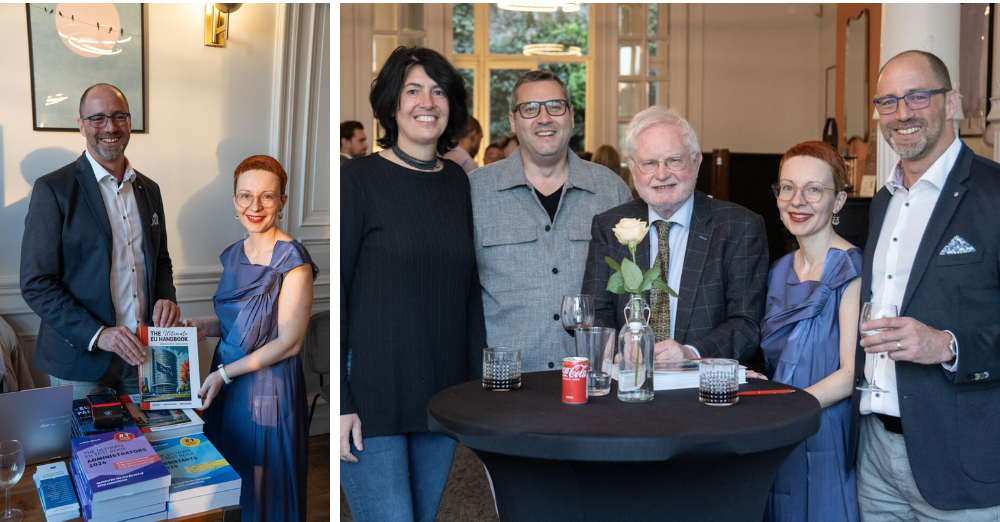
20 years ago, John Harper said 'yes' to an unknown person's unsolicited book pitch, which set of a chain of positive events. Yesterday, another book came to be as a result of two years' intense work and creativity of Sonia Gongu, Martin Tomov, Ljiljana Pavkov... and 'The Ultimate EU Handbook' was born.
Special thanks to Maryana Panyevina, Klym Ahrykov and David Meszaros for your support to make the launch event at Ambiorix Center & Podcast Studio special.
🇪🇺🙏📚
*This was originally posted on Andras Baneth's LinkedIn account.
What began as a discussion about burnout quickly turned into an exploration of something deeper. In my conversation with Dr. Vasadi Anna, a psychiatrist with decades of experience, it became clear that burnout isn’t just about long hours or stress—it’s rooted in expectations, upbringing, and the invisible pressures we internalize from an early age.
English summary of the latest episode of András' Hungarian podcast, 'Lélek Algoritmus – Ilyen az ember (avagy beszélgetések egy pszichiáterrel)' – 'The Soul’s Algorithm: The Human Condition (Conversations with a Psychiatrist).
What began as a discussion about burnout quickly turned into an exploration of something deeper. In my conversation with Dr. Vasadi Anna, a psychiatrist with decades of experience, it became clear that burnout isn’t just about long hours or stress—it’s rooted in expectations, upbringing, and the invisible pressures we internalize from an early age.
Burnout: More Than Just Exhaustion
Burnout gets thrown around a lot, but what does it actually mean? Many assume it’s just extreme fatigue, but as Anna pointed out, it’s something deeper. Burnout drains you emotionally, mentally, and even physically. It’s not the kind of tiredness that a weekend off can fix.
A key distinction Anna made: while depression can affect every part of life, burnout is usually tied to work. But it doesn’t stay there. It spreads—first to colleagues, then to family, then to an overall sense of disillusionment.
The Perfectionist’s Trap
Burnout isn’t just about overworking—it’s about overworking with the wrong mindset. People who push themselves too hard, who never feel their efforts are enough, who equate self-worth with productivity—these are the most at risk.
A common misconception: If I love my work, I can’t burn out. But passion doesn’t shield you. In fact, it often makes things worse. Overcommitting, ignoring personal limits, and relying on caffeine or alcohol to keep up are all red flags.
The Long Shadow of Childhood Expectations
Why do some people burn out while others keep their balance? Often, it starts in childhood.
Many of us grow up believing that our worth is tied to achievement. If we didn’t excel, love and approval felt conditional. Some parents—often unknowingly—reinforce this by setting impossibly high standards or withholding affection when a child falls short. Over time, this creates a need for external validation, making burnout almost inevitable.
Take elite athletes. Their entire identity is wrapped up in performance. When they lose, it’s not just a setback—it feels like a loss of personal value. The same happens in workplaces. A high achiever who misses a promotion doesn’t just feel professional disappointment—they feel like they have failed as a person.
Midlife Crisis: Burnout of the Soul
This naturally led us to midlife crisis, which, in many ways, is burnout playing out on a larger scale.
Both stem from the same root: spending years chasing external markers of success without stopping to ask, Is this what I actually want?
The midlife crisis tends to hit in the 40s or early 50s, often when several pressures collide:
- Aging Parents: The growing responsibility of caring for elderly parents forces many to confront their own mortality.
- Teenage Children: At the same time, kids are becoming more independent, adding another layer of emotional complexity.
- Career Pressures: By midlife, most people have built careers, but many start questioning if they’re on the right path.
It’s a perfect storm of obligations, internal and external, that makes people reevaluate everything—from their job to their marriage to their purpose.
Finding a Way Forward
So, how do we deal with burnout and midlife crisis without making rash decisions?
- Rethink Success – Instead of measuring success by salary, job title, or external validation, define it in terms of fulfillment and balance. If your work is draining you, can it really be called success?
- Recognize the Warning Signs – Losing interest in work, feeling detached, and struggling to muster enthusiasm are all early signs of burnout.
- Set Boundaries – Work will always demand more. It’s up to you to decide what is enough.
- Address Deep-Seated Patterns – If your self-worth depends on achievement, it might be time to rethink where that belief came from. Therapy and self-reflection can help break the cycle.
- Embrace Change – A midlife crisis isn’t necessarily a crisis—it can be a wake-up call. Maybe it’s time for a career shift, a realignment of priorities, or simply a different perspective.
Final Thoughts
Burnout and midlife crisis aren’t just work problems or age-related phases. They’re signals—urgent ones—telling us that something needs to change. The real question isn’t How do I push through? but Am I living a life that actually fits me?
If the answer is no, maybe the crisis isn’t a disaster. Maybe it’s an opportunity.