9 AI Prompts for Public Affairs Professionals Who Want Better Thinking, Not Just Faster Drafting
Discover 9 practical AI prompts for public affairs professionals to improve policy messaging, pressure-test arguments, anticipate objections, and communicate more clearly with EU stakeholders.
“What is the single weakest sentence in this briefing, and how would you fix it?”
This is a prompt I would probably never have come up with myself.
And yet, it is exactly the kind of question that makes AI useful for public affairs work.
Not because it writes the briefing for you.
But because it helps you test the thinking behind it.
A lot of AI use in public affairs still focuses on speed: summarise this, draft that, turn this into an email. Useful, yes. But not the whole story.
The real value is when AI helps you pressure-test your message before someone else does.
A policymaker.
A journalist.
A Commission official.
A sceptical attaché.
A client.
A colleague in the meeting who spots the weak point before you do.
So here are 9 AI prompts for public affairs professionals who want better thinking, not just faster drafting:
- Rewrite this message so it would survive a hostile question from an MEP in the relevant EP committee.
- List the 5 strongest objections a Commission desk officer at [DG] would raise to this proposal, then tighten the argument.
- Translate this policy language into something a national journalist would not misinterpret.
- What is the single weakest sentence in this briefing, and how would you fix it?
- Adapt this message for a sceptical Permanent Representation official who is short on time.
- Strip this text of buzzwords and replace them with concrete, defensible claims.
- Assume the audience is politically neutral but institutionally risk-averse, rewrite accordingly.
- What is the hidden assumption in this argument that could be challenged in a meeting?
- Reduce this to a 30-second spoken answer that sounds credible and not rehearsed.
The point is not to let AI do your public affairs work for you.
The point is to use it as a sparring partner.
To make your arguments clearer.
To make your messages harder to misread.
To find the sentence that sounds fine until someone challenges it.
To prepare for the question you hope no one asks.
That is where AI becomes genuinely useful.
Not as a shortcut around expertise.
But as a tool that helps you use your expertise better.
Stop Using AI for Answers. Start Using It for Better Questions
Discover why the real power of AI isn’t in providing answers, but in helping you ask better questions, uncover blind spots, and explore alternative perspectives for smarter decision-making.
Picasso once said: "Computers are useless, they can only give you answers."
That was true in his time, and still true today if you only use AI as a search ("answer") engine.
The real value is in the questions we ask:
- see blind spots in our reasoning ("Identify hidden biases or blind spots in my plan.)
- test assumptions we didn’t know we had ("Highlight my explicit or implicit assumptions.")
- explore alternative framings of the same problem ("How can this problem be viewed from multiple angles? How would a manager, a psychologist, a physicist, and musician look at it?") Or take these for example:
- Instead of asking “What’s the EU’s position on AI regulation?” try “What unintended consequences could the EU AI Act have for small startups?”
- Instead of “Summarize this report,” try “What’s missing from this report that an NGO focusing on circular economy could ask?”
- Instead of “Write a press release,” try “What would make this story credible to a skeptical journalist?”
AI doesn’t (and shouldn't) replace thinking. Just be sure to ask it the right way.
➡️ looking for AI workshops for your team? Influence Builders has trained 1500+ corporate and government affairs teams, and we'll be glad to work with you.
AI on LinkedIn: Hype, Hysteria, or Honest Insight?
A wry look at the LinkedIn AI conversation: from overhyped promises to doomsday takes, existential musings, and magical shortcuts. Where does reality meet rhetoric?
I get the impression that each time someone talks about AI on Linkedin, it's either:
- "oh this is such a hype/BS that only grifters talk about it"
- "you can go sit on a beach, it'll do everything for/instead of you"
- "whatever it churns out, it's a piece of cr*p that should be ridiculed"
- "here is some existential AI philosophy that I just invented"
- "a magic shortcut to hack your way to the top of the newsfeed"
- "it's the end of [name topic] and let's despair OR here is what to do about it"
- "this is revolutionary and the best of all worlds is about to come"
(I am guilty as charged of some of the above, I readily admit.)
Did I miss anything else?
p.s.: and the opportunistic plug, as the plus one: check out Influence Builders

Large Language Models (LLMs)
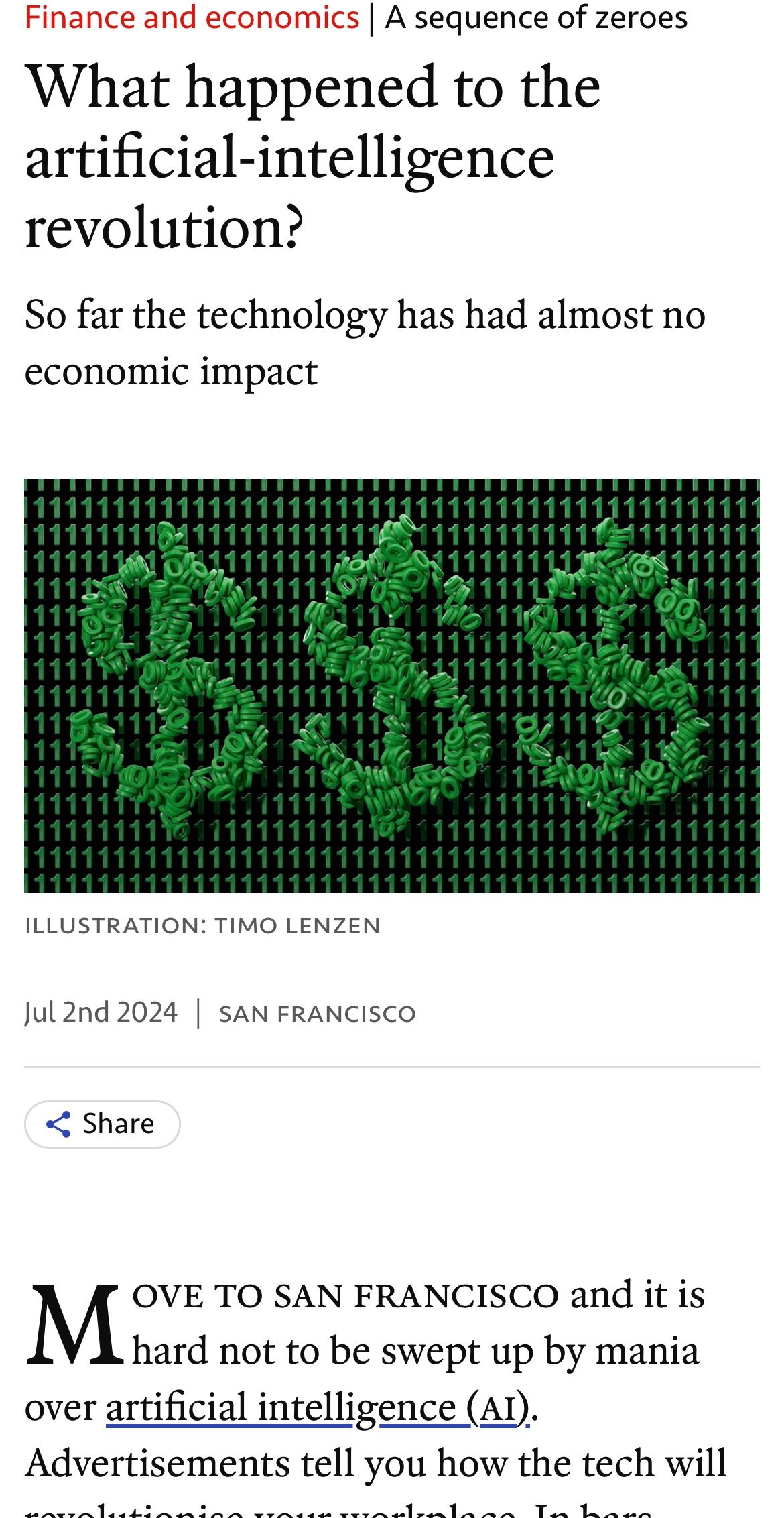
This Economist post is just silly.
This Economist post is just silly.
Cars were invented in the late 1800s but it took 30+ years for them to become mainstream (Ford Model T, anyone?)
Electricity was first harnessed around the same time but it took 50+ years to become omnipresent.
The Wright brothers made their first successful powered flight in 1903. Commercial flying did not become mainstream before the 1960s.
Expecting #AI to become widely adopted in 1.5 years and already see its transformative, revolutionary power will also take time albeit much less than the above examples.
Think of social networking: it took around two decades between MySpace and Facebook to have a massive impact on elections, mental health, and global culture.
The power of Large Language Models (LLMs) is here, and it will shape our lives in more ways than we can imagine.
Are you ready?
GPT: Eager, Smart and Ignorant
There are the 3 strengths/weaknesses of #GPT: it's eager, smart, and ignorant.
There are the 3 strengths/weaknesses of #GPT: it's eager, smart, and ignorant.
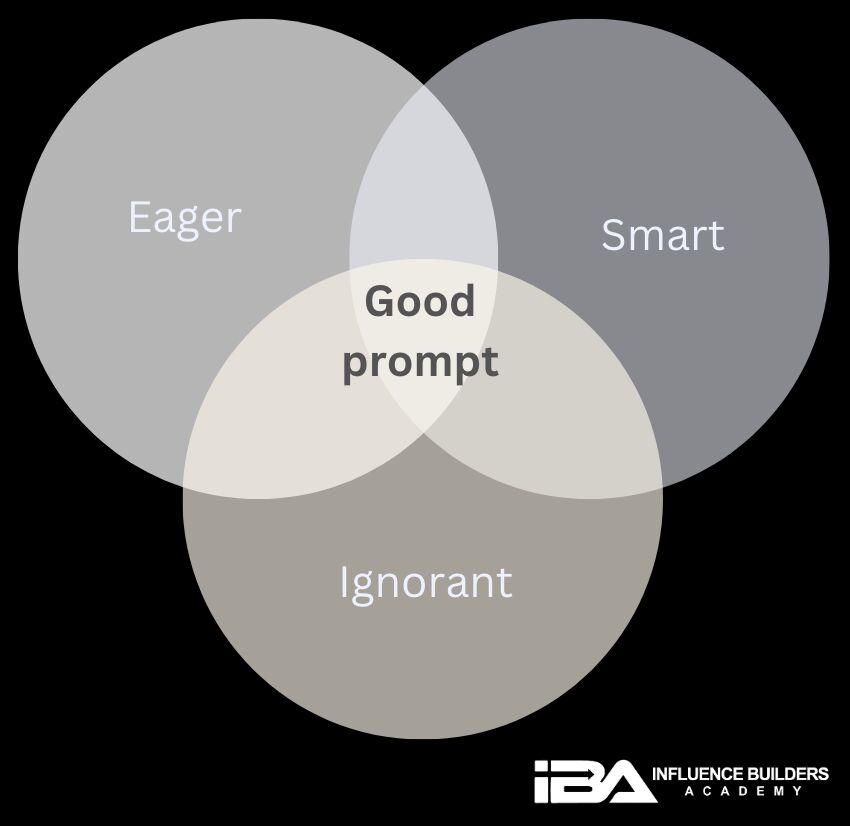
What does that mean?
1. Eager: it wants to please you, so it will give detailed replies even based on an incomplete or basic prompt, but that often means the user (you) will not be satisfied with the reply, or worse, consider the AI useless or overhyped. You need to tame this zeal by proper instructions, more background/context, and specifying what you need in detail.
2. Smart: the AI has excellent reasoning, computing, processing, and even 'creative' "skills". Feeding in structured and multi-faceted data can be processed very quickly and in most cases, quite accurately. This is one of its strongest abilities so it can be harnessed to the fullest extent.
3. Ignorant: based on its large dataset and access to live online information, GPTs are of course not lacking knowledge. What they do lack is *your* specific background information, context, explanation, Excels and Docs and PDFs that you probably want to feed into them so they can provide relevant, personalized, custom replies instead of needing to rely on "what's out there"
....and to harness GPTs' true power, it starts with a high-quality prompt.
(Hope this is helpful - if so, please share it with your network.
The EU's "Strategic Agenda 2024-2029"
The EU's "Strategic Agenda 2024-2029" has just been released.
The EU's "Strategic Agenda 2024-2029" has just been released. Aside from pundits, does anyone care? How about making it more interesting with #EUGPT's power to...
1) turn it into a rap song, Eminem-style?
"Got a world that’s unstable, wars back on the table,But we’re stronger together, we’re nothin’ if not able,Ukraine’s got our support, against aggression they fought,We’re the shield, we’re the sword, in this global retort."
2) ...or a Shakespearean verse?
"To Europe’s peace, we pledge our hearts and might,In unity, we face the tempest’s roar.With valor, fight for justice, day and night,Forsooth, our Union stands forevermore."
3) ...or an Obama-style speech?
"My fellow Europeans, in unity we rise, facing challenges with courage and resolve. Together, we’ll lead the charge against climate change and champion our shared values of democracy and peace. Let’s embrace innovation, support our neighbors, and ensure a prosperous future for all. Yes, we can!"
4) ...or a Trump-style rally?
"Folks, Europe is strong, we’re making it great again, believe me. We’re tackling climate, boosting security, and supporting Ukraine big league. We’re protecting our borders, and our economies will be the best ever. Together, we’ll win like never before!"
5) ...or a speech by the Pope?
"Beloved Europeans, let us unite in peace and solidarity, guided by love and justice. Together, we shall protect our Earth and support those in need. May our efforts bring prosperity and harmony to all. With God’s grace, we shall overcome."
6) ...or a rhythmic verse only with words starting with "E"?
"Europe embraces evolution, enhancing environmental efforts. Economic empowerment ensures equitable growth. Embracing unity, Europe endures. Envisioning a future, Europe excels."
#AI is powerful if used creatively. Let's keep experimenting ✌️
US Presidential Election Debates
US Presidential election debates are usually fun and entertaining political communication shows.
US Presidential election debates are usually fun and entertaining political communication shows. The one last night was painful on many levels, not only for seeing that “the emperors are naked” (not a pleasant experience in the first place) but also because the world needs a strong and democratic USA with leaders who are morally and cognitively up to the job. As a European with a lot of respect for the country and connection with so many wonderful Americans, I just wish a good/better way forward come this November. We need you to rediscover your roots, integrity, and strength.
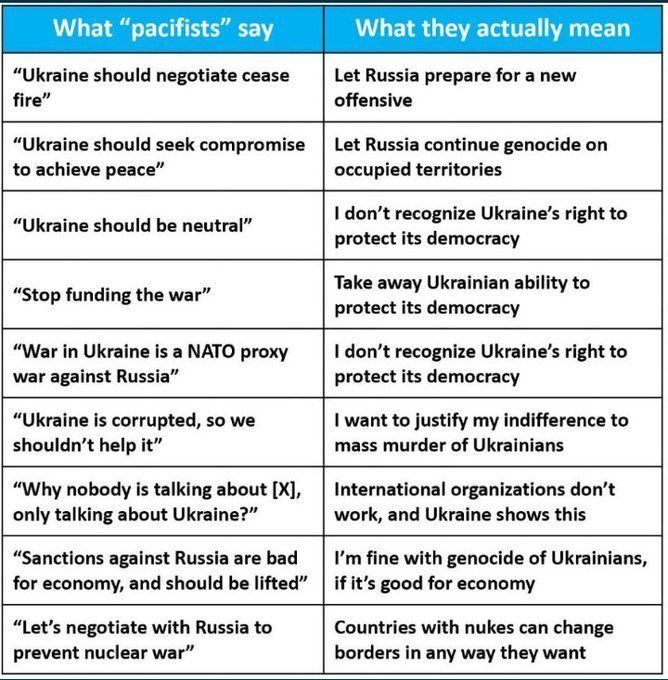
How to Use AI to Reach Your Target Audience
I wonder how my message will resonate with [fill in the audience]?
"I wonder how my message will resonate with [fill in the audience]?"
Wonder no more: you can do pretty effective message testing with lookalike personas using AI/GPT.
All you need to do is be specific and detailed enough to make it work, and you don't even need to come up with the specific audience attributes yourself.
Give a prompt along the lines of : "Create a detailed persona of a Member of the European Parliament based on 10 political and personal attributes, but first ask me for these attributes one by one so I can provide you the right input. When that persona is ready, give it a name so I can use it as a reference."Once this is done, you can "throw" messages at this "persona", but you can just as well have GPT generate messages that *will* resonate with this persona, along the lines of your policy or advocacy priorities.
...and this is just to get started ✌️
TEDx Talk Lessons: Aligning Your 3 Speeches
Guido, my no-nonsense speaker coach, told me: "There are always 3 speeches we give: the one we plan to give, the one we actually give, and the one we wish we had given."
Guido, my no-nonsense speaker coach, told me: "There are always 3 speeches we give: the one we plan to give, the one we actually give, and the one we wish we had given."
The closer these three are to each other, the better the outcome.
Two months ago I had the privilege to give another TEDx talk called 'Your Words Will Shape Your World'.
The talk, and the video, will only be available in a few weeks, but I wrote a short article about 'How giving a TEDx talk actually works' in case you're interested in the behind-the-scenes report: https://lnkd.in/eDUV7Bq4
European voters and Gaza - Reply to Shada Islam's piece in EUobserver
Shada Islam’s opinion piece “While EU leaders look away from Gaza's agony, European voters do care”, published on EU Observer on 4 June 2024, is a striking example of how a self-proclaimed “progressive” can abuse noble ideals, such as promoting the rule of law and defending human rights, in the pursuit of sectarian identity politics.
Shada Islam’s opinion piece “While EU leaders look away from Gaza's agony, European voters do care”, published on EU Observer on 4 June 2024, is a striking example of how a self-proclaimed “progressive” can abuse noble ideals, such as promoting the rule of law and defending human rights, in the pursuit of sectarian identity politics.
The price of the most recent war that Hamas and its regional allies started against Israel is undoubtedly very high, both for Palestinian and for Israeli civilians, the latter of whom Ms Islam rarely, if ever, considers worthy of more than a fleeting mention. In addition to those who were killed, raped, and kidnapped on 7 October 2023, tens of thousands of Israelis have been displaced from their homes partly because the entirety of Israel has been subject, already well before the so-called “Al-Aqsa flood”, to relentless and indiscriminate bombings and rocket attacks by Hamas, Hezbollah, and Iranian forces. The only reason that the Israeli civilian death toll is not higher is because Israel decided to use its resources to defend its people with the ‘Iron Dome’ and other protective systems, not due to the lack of the attackers’ will.
Civilian casualties are always the terrible price of wars. When referencing the “laws of war”, however, including International Humanitarian Law, it becomes a legal question what these laws allow or prohibit. While tragic, the killing of civilians for the achievement of legitimate military objectives, under several constraints, is in fact allowed by these laws. Assessing whether Israel is respecting the relevant conditions under the law is a difficult exercise that must be based on a dispassionate, objective, and informed knowledge of relevant facts. Social media sources, more often manipulated than not, and propaganda outlets, even if often uncritically echoed by ‘reputable’ news organizations, are not a good basis for such assessments.
Too many people, Ms Islam included, seem to ignore this very simple exercise, to the point that even Joan Donoghue, the former President of the International Court of Justice, had to take the unprecedent step of publicly clarifying that the ICJ had not taken any position concerning the factual truth of the South African accusations of genocide against Israel; nor on the existence of a “plausible genocide”, as the quote in Ms Islam’s piece might erroneously suggest.
Much of the data that is given amplification and credence is largely, if not entirely, coming from Hamas, whose Orwellian-named ‘Gaza Health Ministry’ and ‘Government Media Office’ should not be trusted by anyone who cares about facts and evidence. Yet, such data is often repeated uncritically not only by well-meaning, if misguided, protesters, but also by top political leaders, in Europe and elsewhere, who really should know better if only they were willing to try.
It is hard to understand how Ms Islam, and many others, can use in good faith axioms such as “egregious breaches of international law” and “blatant violations of human rights”, implying that Israel is the one committing these, without any qualification – unless, of course, those terms refer to Hamas’ past and current actions. This does not seem to be Ms Islam’s position, however.
The truth is that massacring, torturing, and kidnapping civilians in a systematic, premeditated way is a sure-fire way to trigger a war, which is why it is a good idea not to commit them in the first place. Even less so if the rulers of the land claim to care about the well-being of their own people. All the while Hamas has made no secret of its intention to repeat the October 7 attack “again, and again, and again”, using their (now waning) military capabilities.
Another truth, as proven by evidence, is that the leaders of Hamas and their supporters only exploit and oppress Palestinian people to advance their apocalyptic-nihilistic ideology using cheap labor (often including children) to dig terror tunnels, or as cannon fodder for their genocidal “from the river to the sea” agenda, or as pawns for their anti-Israel, antisemitic propaganda campaign.
A third truth is that, if it wanted to, Hamas could stop this war, which Israel did not want and did not start, in a heartbeat: by returning all living and murdered hostages and unconditionally surrendering.
Finally, Ms Islam clearly suggests that the underlying reason for what she laments as a “double standard” in Europe – where, apparently, we “cheer” for Ukraine, but not for Palestinians – lies in our “racism” and “dehumanisation”.
She is, of course, entitled to her opinion.
Another way to look at it is that many Europeans understand perfectly well that Russia launched a war of aggression against Ukrainian people, with the stated goal of erasing their very identity, while Israel is also defending its very existence against a genocidal movement which has amply demonstrated both the willingness and the ability to kill Israelis. These Israelis live in a country where close to 20% of its citizens are in fact Arabs, enjoying the same rights and obligations as every other citizen, and where more than half of its citizens are “brown and black people”, to use Ms Islam’s words, all the while they, too, are the targets and victims of indiscriminate attacks by Israel’s enemies.
Most Europeans are aware that Israel has demonstrated, time and again, its openness to peaceful co-existence with other countries in the region, one of the most stellar examples of which is the conclusion of the Abraham Accords in 2020. Today it is nevertheless fighting against an enemy which has brazenly diverted (read: misused and stolen) billions of European and US taxpayers’ money, originally intended to aid civilians in Gaza. This money, generously provided despite Ms Islam’s accusations of “racism” and “dehumanisation”, was used by Hamas not to invest in Gaza’s future but rather to build more tunnels than the length of the entire London Underground, and to fully embed itself within the civilian population whom it cynically considers as nothing more than human shields and potential “martyrs”.
In short, it is important to understand that equating completely different situations is just another form of “double standard”, which Ms Islam laments, but does not seem to apply to her own reasoning. This helps neither progressive values nor the people in the Middle East.
Featured articles
and Insights
This compilation takes us through the history of the first #EPSO candidates, showcasing their journey and achievements from the very beginning to the present day—and even looking ahead.
A compilation of the first #EPSO candidates throughout history, until today and beyond.
(Have you played with ChatGPT-4o's new image capabilities? Pretty impressive.)
*This was originally posted on Andras Baneth's LinkedIn account.
Discover the inspiring story behind The Ultimate EU Handbook, a book born from the unexpected connection of a chance pitch and years of creative collaboration.
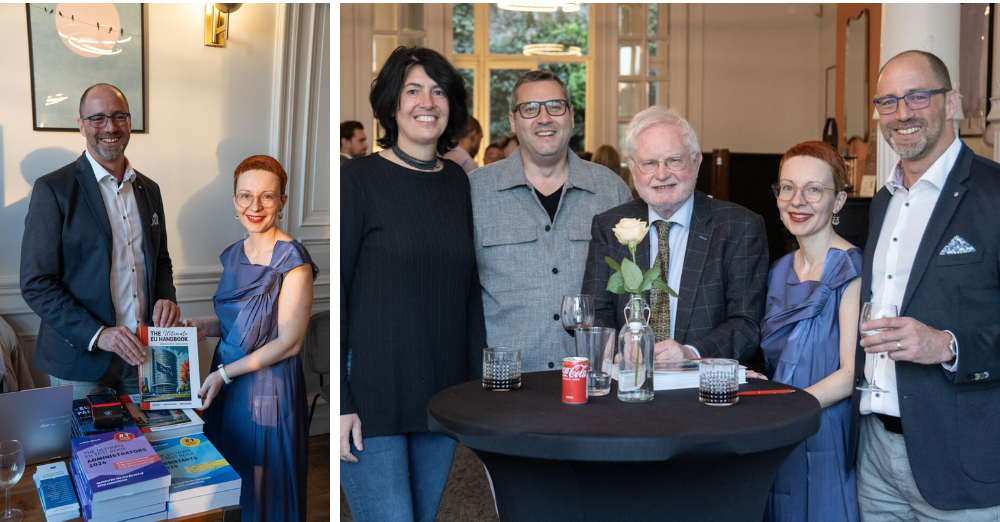
20 years ago, John Harper said 'yes' to an unknown person's unsolicited book pitch, which set of a chain of positive events. Yesterday, another book came to be as a result of two years' intense work and creativity of Sonia Gongu, Martin Tomov, Ljiljana Pavkov... and 'The Ultimate EU Handbook' was born.
Special thanks to Maryana Panyevina, Klym Ahrykov and David Meszaros for your support to make the launch event at Ambiorix Center & Podcast Studio special.
🇪🇺🙏📚
*This was originally posted on Andras Baneth's LinkedIn account.
What began as a discussion about burnout quickly turned into an exploration of something deeper. In my conversation with Dr. Vasadi Anna, a psychiatrist with decades of experience, it became clear that burnout isn’t just about long hours or stress—it’s rooted in expectations, upbringing, and the invisible pressures we internalize from an early age.
English summary of the latest episode of András' Hungarian podcast, 'Lélek Algoritmus – Ilyen az ember (avagy beszélgetések egy pszichiáterrel)' – 'The Soul’s Algorithm: The Human Condition (Conversations with a Psychiatrist).
What began as a discussion about burnout quickly turned into an exploration of something deeper. In my conversation with Dr. Vasadi Anna, a psychiatrist with decades of experience, it became clear that burnout isn’t just about long hours or stress—it’s rooted in expectations, upbringing, and the invisible pressures we internalize from an early age.
Burnout: More Than Just Exhaustion
Burnout gets thrown around a lot, but what does it actually mean? Many assume it’s just extreme fatigue, but as Anna pointed out, it’s something deeper. Burnout drains you emotionally, mentally, and even physically. It’s not the kind of tiredness that a weekend off can fix.
A key distinction Anna made: while depression can affect every part of life, burnout is usually tied to work. But it doesn’t stay there. It spreads—first to colleagues, then to family, then to an overall sense of disillusionment.
The Perfectionist’s Trap
Burnout isn’t just about overworking—it’s about overworking with the wrong mindset. People who push themselves too hard, who never feel their efforts are enough, who equate self-worth with productivity—these are the most at risk.
A common misconception: If I love my work, I can’t burn out. But passion doesn’t shield you. In fact, it often makes things worse. Overcommitting, ignoring personal limits, and relying on caffeine or alcohol to keep up are all red flags.
The Long Shadow of Childhood Expectations
Why do some people burn out while others keep their balance? Often, it starts in childhood.
Many of us grow up believing that our worth is tied to achievement. If we didn’t excel, love and approval felt conditional. Some parents—often unknowingly—reinforce this by setting impossibly high standards or withholding affection when a child falls short. Over time, this creates a need for external validation, making burnout almost inevitable.
Take elite athletes. Their entire identity is wrapped up in performance. When they lose, it’s not just a setback—it feels like a loss of personal value. The same happens in workplaces. A high achiever who misses a promotion doesn’t just feel professional disappointment—they feel like they have failed as a person.
Midlife Crisis: Burnout of the Soul
This naturally led us to midlife crisis, which, in many ways, is burnout playing out on a larger scale.
Both stem from the same root: spending years chasing external markers of success without stopping to ask, Is this what I actually want?
The midlife crisis tends to hit in the 40s or early 50s, often when several pressures collide:
- Aging Parents: The growing responsibility of caring for elderly parents forces many to confront their own mortality.
- Teenage Children: At the same time, kids are becoming more independent, adding another layer of emotional complexity.
- Career Pressures: By midlife, most people have built careers, but many start questioning if they’re on the right path.
It’s a perfect storm of obligations, internal and external, that makes people reevaluate everything—from their job to their marriage to their purpose.
Finding a Way Forward
So, how do we deal with burnout and midlife crisis without making rash decisions?
- Rethink Success – Instead of measuring success by salary, job title, or external validation, define it in terms of fulfillment and balance. If your work is draining you, can it really be called success?
- Recognize the Warning Signs – Losing interest in work, feeling detached, and struggling to muster enthusiasm are all early signs of burnout.
- Set Boundaries – Work will always demand more. It’s up to you to decide what is enough.
- Address Deep-Seated Patterns – If your self-worth depends on achievement, it might be time to rethink where that belief came from. Therapy and self-reflection can help break the cycle.
- Embrace Change – A midlife crisis isn’t necessarily a crisis—it can be a wake-up call. Maybe it’s time for a career shift, a realignment of priorities, or simply a different perspective.
Final Thoughts
Burnout and midlife crisis aren’t just work problems or age-related phases. They’re signals—urgent ones—telling us that something needs to change. The real question isn’t How do I push through? but Am I living a life that actually fits me?
If the answer is no, maybe the crisis isn’t a disaster. Maybe it’s an opportunity.